

Beachfront vs Ocean View Property in the Dominican Republic
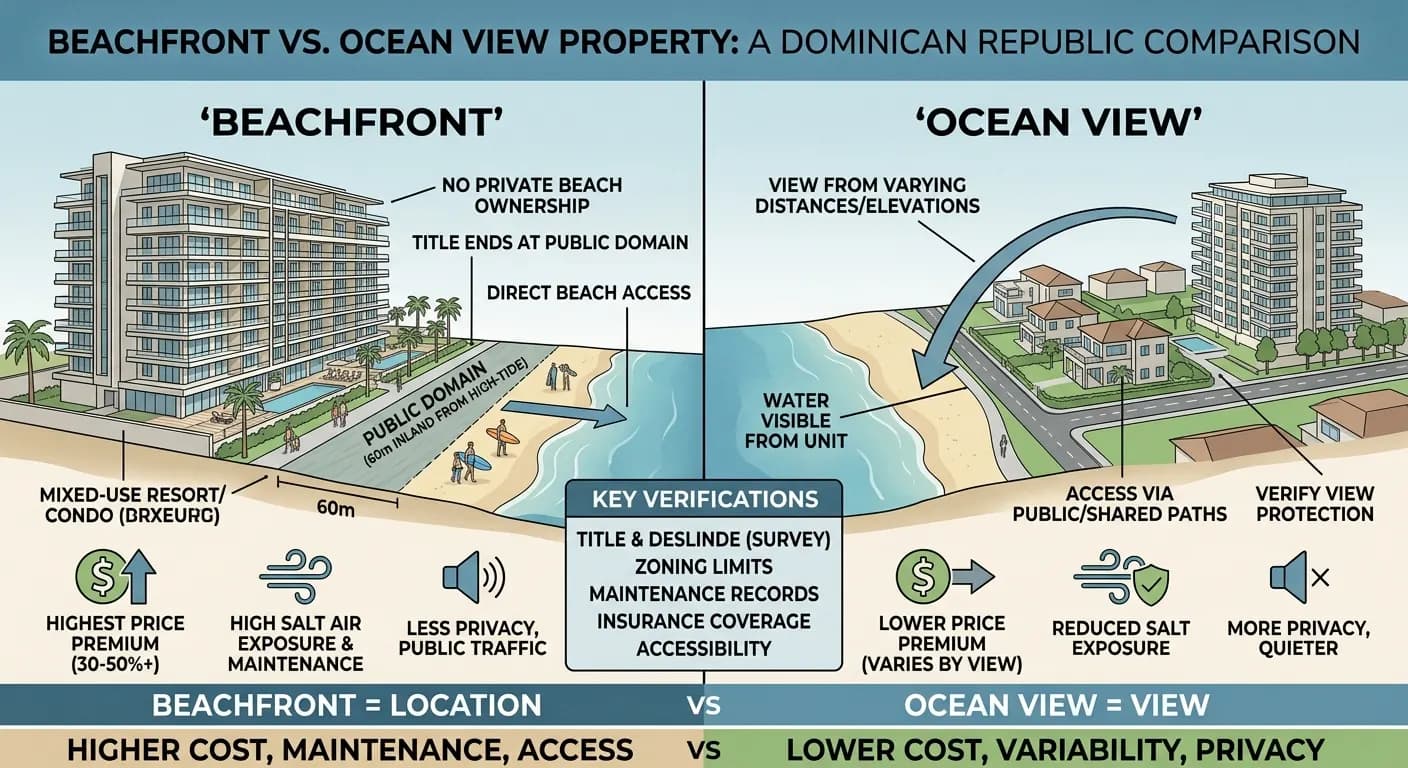
Short answer: In the Dominican Republic the first 60 metres inland from the high-tide line are public domain, so no title includes the sand itself. "Beachfront" means your lot or building sits next to that public strip. "Ocean view" means you can see the water, often from further back. Neither term is regulated in a listing, so verify the distance, the survey line and the upkeep before you pay for either.
What does "beachfront" actually mean in the Dominican Republic?
It means proximity and view, not private sand. A strip 60 metres wide, measured inland from the ordinary high-tide line, is public domain along every Dominican coast. It cannot be sold, and nobody can acquire it by occupying it over time. The rule goes back to Law 305 of 1968 and is reinforced by the General Environmental Law 64-00, according to Dominican real-estate and legal commentary.
Your private title therefore starts where that strip ends. A Dominican law firm's introduction to the legal framework says adjoining owners may build in the strip only with special presidential authorization, and the same point appears in several independent sources.
Two practical consequences:
- Public access stays public. A Constitutional Court ruling, TC/0751/23 of December 2023, is cited by Dominican commentators as confirming removal of barriers that blocked a public path to a beach in Samaná. An owner cannot fence the beach in front of the house.
- Anything built inside the strip is a question. Construction there is prohibited as a general rule, with exceptions the government can authorize for tourism or public-utility projects. A terrace, wall or beach bar near the waterline is either operating under such an authorization or carries removal risk. One legal-commentary source says unauthorized works face court-ordered demolition at the owner's cost.
There is also a nuance. One source notes that rights that already existed when the 1968 law passed were preserved, so some old titles may reach into the strip. The same source says the construction ban would still apply. Whether a particular title qualifies is a lawyer's question, not something to assume.
Beachfront, ocean view, beach access: how do the three differ?
The terms sound graded, but they describe different things.
| Term | What it usually means | What to verify |
|---|---|---|
| Beachfront / oceanfront | The property is adjacent to the public strip or the shoreline. | Where the title line sits relative to the high-tide mark; the surveyed boundary (deslinde). |
| Ocean view | Water is visible from the unit, sometimes from a higher floor or a distance. | Whether the view is protected or can be blocked by a future building. Look from the actual floor and orientation. |
| Beach access / walking distance | A route to the sand, public or inside a community. | The real walking time, the route, and whether the access is public, shared or private. |
| Near the beach | A marketing phrase with no fixed meaning. | The distance in metres, measured. |
Sosúa Ocean Village, for example, describes more than 600 metres of coastline within the community. That is the community's own description. What you can use of it, as a buyer, depends on the specific unit and the community rules. See the Sosúa Ocean Village page and the Sea Horse Ranch page, where the community describes several miles of semi-private beach. "Semi-private" is the community's wording, and given the public-strip rule it is worth asking exactly what is meant.
How much more do you pay for beachfront or a sea view?
There is no reliable north-coast figure, so none is given here.
One Samaná-based data provider reports that, on its own listing data, oceanfront condos and villas ask roughly 40% more than equivalent inland units. That is asking-price data for the Samaná peninsula only, not closed sales, and it should not be read across to Sosúa, Cabarete or Puerto Plata. We found no published premium for the north coast.
What you can do is compare like with like. Take two units in the same building or community, same size and condition, one with a view and one without, and ask the agent for the actual asking and sold prices. The difference is the premium for that spot. Anything else is a guess.
Also remember what the premium buys. You are paying for position, light and the view, plus whatever the title and community rules give you. You are not paying for ownership of the sand.
What are the costs and risks of being close to the sea?
Salt air is the one risk that nearly every coastal owner meets, and it is not exotic.
Instyle's own maintenance guidance says airborne salt settles on metal and speeds corrosion, naming railings, gates, hinges, screws and air-conditioning components. It recommends rinsing metal with fresh water regularly and notes that 316-grade stainless steel resists chloride corrosion better than ordinary steel. It also flags humidity: closets, bathrooms and AC systems need regular attention, and a leak caught after a week is a maintenance task while the same leak found after three months can become a renovation. That guidance is Instyle's own, not an independent source, and it gives no cost figures. The full article is Maintaining beachfront property in the Dominican Republic.
Storms matter too. The U.S. State Department notes that tropical storms and hurricanes with heavy rain and wind occur in the Caribbean generally from May through November, and that flooding can happen without warning. For how the north coast fares, see hurricanes on the north coast.
On erosion we found no north-coast source that we could cite. We therefore make no claim about shoreline retreat at any specific beach. If you are looking at a lot or building close to the water, ask for the survey, ask neighbours about past storm damage, and have an engineer inspect the foundation and drainage.
What should you check before paying for a coastal location?
A short list, roughly in the order it matters:
- Title and survey. Your attorney should confirm the registered title and that the boundary, as surveyed, does not run into the 60-metre strip.
- Structures near the water. Ask for the authorization documents for anything built close to the shoreline. Missing paperwork is a warning sign.
- Zoning limits. Tourism-zone rules can cap height and density in the first line of land. One source cites a limit of two levels and 7 metres for the first 40 metres of private land in Samaná under a tourism-ministry resolution. We did not verify whether the same rule applies in Puerto Plata province, so ask the municipality or your attorney.
- View protection. If you are paying for a view, check what can be built in front of it.
- Insurance. Ask what is covered for storm, flood and corrosion damage, and who pays the premium: you, or the building.
- Maintenance records. Request the history for AC units, metalwork, roof and waterproofing.
- Access in practice. Walk from the unit to the sand. Time it. Note any steep path, road crossing or locked gate.
This is general information, not legal advice. A Dominican attorney reviews the title and the survey for the actual parcel.
Frequently asked questions
Can I own the beach in front of my property in the Dominican Republic? No. The first 60 metres inland from the high-tide line are public domain and cannot be privately owned or blocked. Your title starts where that strip ends, unless an old pre-1968 title says otherwise, which only a lawyer can assess.
Is beachfront the same as oceanfront? In listings the two words are used almost interchangeably, and neither has a fixed legal definition. Ask for the distance from the building or lot line to the high-tide line and for the surveyed boundary.
Is an ocean view worth paying more for? That depends on the view and on whether it is protected. Compare asking and sold prices of comparable units with and without a view in the same building. We found no published north-coast price premium.
Does salt air really damage a coastal home? It can corrode exposed metal and stress air-conditioning equipment, and humidity encourages mould. The practical response is regular rinsing, corrosion-resistant materials and routine inspections, and a maintenance record you can read before buying.
Can foreigners buy beachfront property? Yes, foreigners have the same property rights as Dominicans. The 60-metre strip applies to everyone, so the question is where the title ends, not who the buyer is.
Next step
Choose one listing you like and ask the agent for three things in writing: the surveyed boundary relative to the high-tide line, the maintenance history of the exposed metal and AC, and the asking and sold prices of two comparable units. Browse current listings, or contact Instyle about a specific property. For the buying process, see the guide to buying property in the Dominican Republic.
Sources
- Guzmán Ariza, Introduction to the Legal Framework (60-metre coastal strip): https://drlawyer.com/introduction-to-the-legal-framework/
- Evalúa, Beachfront Land DR: 60-Metre Maritime Strip (Law 305-68, Law 64-00, TC/0751/23, MITUR Res. 06/2011, Samaná asking prices): https://www.evalua.do/articles/beachfront-land-dominican-republic-60-metre-maritime-strip
- Mamajuana Travel, Are Dominican Republic Beaches Public?: https://mamajuanatravel.com/blog/are-dominican-republic-beaches-public
- DR1 forum, 60 meter rule in buying ocean front property: https://dr1.com/forums/threads/60-meter-rule-in-buying-ocean-front-property.119116/page-3
- Instyle Investments, Maintaining Beachfront Property in the Dominican Republic: https://instyleinvestments.com/blog/maintaining-beachfront-property-dominican-republic
- U.S. Department of State, Dominican Republic travel advisory and guidance: https://travel.state.gov/en/international-travel/travel-advisories/dominican-republic.html
- Sosúa Ocean Village, official site: https://sosuaoceanvillage.com/
Last reviewed: October 1, 2026
 بقلمJustian Hankeمسؤول المبيعات الرقمية
تابع القراءة
- الحياة في Sosúa: دليل المنطقة و134 عقارًا
- الحياة في Cabarete: دليل المنطقة و28 عقارًا
- الحياة في Puerto Plata: دليل المنطقة و5 عقارات
- الحياة في Sosua Ocean Village: دليل المنطقة و14 عقارًا
- الحياة في Sea Horse Ranch: دليل المنطقة و10 عقارات
- شراء العقارات في جمهورية الدومينيكانتكاليف إتمام الصفقة، وضريبة العقار، وCONFOTUR، وإجراءات الشراء
- Price per Square Meter in Sosúa and Cabarete: What Instyle's Listings Showالمجلة
- Best Gated Communities in Sosúa & Cabarete – 2026 Guideالمجلة