

Dominican Republic Property Title Due Diligence: What Your Attorney Checks
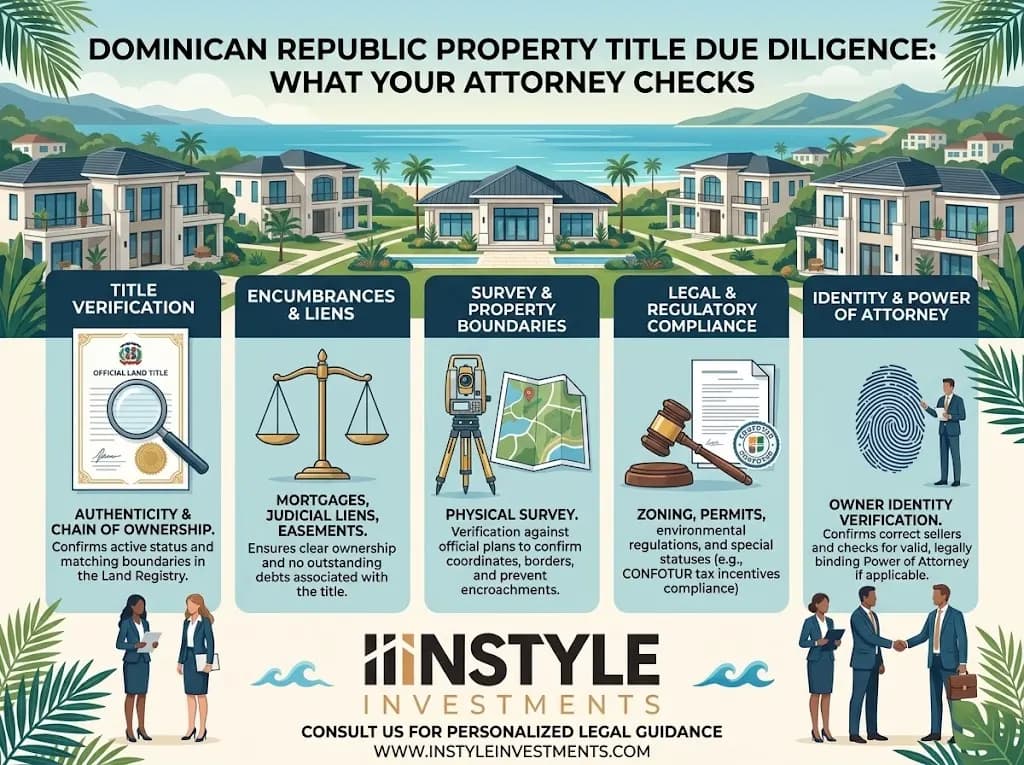
Short answer. A Dominican certificate of title shows who is registered as owner, for which parcel, at the time it was issued. It does not show current liens, lawsuits or disputed boundaries. Your attorney checks those through a current status certificate from the Registro de Títulos, a survey, the seller's tax and corporate papers, permits and possession. A clean review lowers risk; it does not guarantee a result.
General information, not legal advice; a Dominican attorney reviews the individual property.
What does a Dominican title certificate actually show?
The Certificado de Título is issued by the Registro de Títulos, part of the land registry system known as the Jurisdicción Inmobiliaria. The system dates back to a Torrens-style registration introduced in 1920 and now runs under Property Registry Law 108-05, in force since April 4, 2007 (Guzmán Ariza, Century 21 Perdomo). Registration is what proves ownership. A signed contract or possession does not.
One Punta Cana firm that represents only buyers breaks the certificate into six fields (CanaLaw):
| Field | What it tells you | What to compare it against |
|---|---|---|
| Matrícula | The registry number of the property | It must match every other document, including the contract |
| Propietario | The registered owner | The person or company signing as seller |
| Designación catastral | The reference linking the record to the surveyed parcel | The survey plan |
| Superficie | The registered area in square meters | The area in the contract and in the listing |
| Ubicación | Section, municipality and province | The place you actually visited |
| Linderos | The boundaries, north, south, east and west | The survey and the site |
Check the colour first. A blue certificate is a Certificado de Título: individual ownership of a delimited parcel. A pink one is a Constancia Anotada: a right to a number of square meters inside a larger, undivided parcel, with the exact location not fixed. The firm calls this the most overlooked distinction for foreign buyers. It does not make a purchase impossible, but it changes what you are buying, so the attorney should explain it in writing before you pay anything.
What does the certificate not show?
It does not show what happened after it was issued. By the CanaLaw account, the certificate says nothing about current liens, litigation, third-party claims, easements, boundary disputes or inheritance claims. The document that shows the present status is the Certificación de Estado Jurídico, which the attorney requests directly from the Registro de Títulos. It lists the annotations recorded against the property, such as mortgages, liens, litigation holds and restrictions.
Two details are worth asking about. First, the age of the status certificate. One firm states that it is valid for 30 days and should be current at closing (CanaLaw); that period comes from a single source, so ask your attorney what applies. Second, the origin of the copy. Guzmán Ariza advises that the buyer's attorney should not stop at the registry's certification but confirm the result by investigating the files at the registry. The same CanaLaw account notes that falsified certificates exist, which is why a copy handed over by the seller or developer is not enough.
Which documents should the seller provide?
Guzmán Ariza lists what the seller should hand over so the due diligence can start:
- A copy of the certificate of title.
- A copy of the official survey or plat plan (the deslinde). Under Law 108-05, as the firm describes it, sales of properties without a government-approved plot generally cannot be recorded at the registry, with narrow exceptions.
- The seller's ID or passport, and the spouse's if the seller is married.
- The last property tax (IPI) receipt or an exemption certificate, and a certification from the tax office that the seller is current.
If the seller is a company, add the bylaws, an up-to-date Mercantile Registry registration, a resolution authorizing the sale and a tax-office certification covering income tax and the tax on assets. For a condominium unit, add the condominium declaration and regulations, the approved construction plans, a certification from the administration that dues are paid, and the minutes of the last three condominium meetings. For a house, add the approved construction plans, an inventory of what is included, and the utility contracts with proof that the seller is current.
A seller who says a document is "not necessary" is making a decision for you. A cooperative seller sends the whole list.
What does the attorney check beyond the paper?
Guzmán Ariza's checklist, with the points that matter most for the North Coast:
- Title search. A certification from the registry on owner, mortgages, liens and encumbrances, confirmed by the attorney's own look at the registry files.
- Survey. An independent surveyor confirms that the land to be sold matches the plan the seller presents. The firm describes cases where a buyer received title to a parcel some distance from the one he thought he was buying, through a careless earlier survey or seller fraud. The check applies even when the seller supplies a government-approved plan.
- Improvements. A qualified builder or architect examines the house or condo and compares it with the approved plans.
- Permits and use. Confirmation that the property can be used as you intend. Law 305 of 1968 creates a 60-metre maritime zone from the high-tide mark inland, and building there needs a special permit from the executive branch. Tourist areas carry additional building restrictions administered by the Ministry of Tourism.
- Possession. That the seller actually holds the property, with no squatters' claims. The firm notes that tenants are protected and eviction is slow and costly.
- Employees. Severance for any staff must be settled by the seller, otherwise the buyer may be liable later.
- Utilities. No unpaid power, water, cable or phone bills.
Century 21 Perdomo adds two items to its description of a complete review: a chain-of-title check going back 10 to 20 years to find inheritance gaps and informal transfers, and a question that is easy to forget, namely what the DGII's assessed value is and whether it matches the sale price. The transfer tax is calculated on the higher of the two.
CanaLaw puts the chain-of-title period at 20 years and lists inheritance disputes among the most common title problems. Both firms name incomplete inheritances, such as a seller whose co-heirs never signed, as a common reason a claim can outlive the sale. Sellers who inherited a family property informally deserve extra care.
What changes for a condo or a new build?
The question of who owns the land comes first. CanaLaw points out that in pre-construction projects the registered owner is sometimes not the developer but the original landowner or a land-holding company; a developer with only a purchase agreement cannot transfer clear title. Ask for a written legal explanation of the chain between the registered owner and the seller.
The second issue is the developer's financing. Guzmán Ariza describes a common pattern: the developer funds construction with buyers' payments plus a bank loan secured by a mortgage on the land. If the developer fails, the bank can foreclose. For that reason it recommends tying payments to clear title and construction progress and, where possible, using an escrow agent, which it says is rarely done.
For finished condos in an established community, the documents above (declaration, regulations, dues certification, minutes) show how the building is run. Established gated communities such as Sosúa Ocean Village, Sea Horse Ranch and Casa Linda are among the places where a Sosúa and Cabarete brokerage reports that title problems are rare there compared with single homes, older buildings and rural land. That is one broker's observation, not a guarantee for any particular unit.
How long does a title review take, and what does it cost?
Century 21 Perdomo gives 7 to 21 days for standard urban and suburban properties and 30 days or more when inheritance or boundary questions arise. CanaLaw offers its own review in 5 to 7 business days. Both are marketing figures from firms that sell the service, so use them as a rough guide.
On cost, the review is normally part of the attorney's fee of 1% to 1.5% of the purchase price, as Guzmán Ariza describes, with a minimum for properties of US$150,000 or less (Guzmán Ariza). Ask whether the survey is included. A 2018 page from a UK property portal put surveyor fees at around US$350 to US$450; treat that as a historical reference (Rightmove Overseas).
Title insurance is a place where the sources contradict each other. The same 2018 page says it has become normal for buyers to take it out, at around 1% of the price. CanaLaw says it does not exist in the country, and Century 21 Perdomo says the North American kind is not widely available, although some international providers offer policies. Ask your attorney whether any product is available for your property; do not assume one is.
When the review turns up a problem, the outcome depends on the problem. A small boundary discrepancy can be corrected through a cadastral regularization that the seller has to cooperate with, which the brokerage puts at 30 to 90 days. A missing heir's signature has to be obtained. An active claim by the government is a reason to walk away. Your promise of sale should say what happens to your deposit in each case.
For buyers new to the area, our guides to buying property in Sosúa and Cabarete real estate describe the local markets; if you want a property's documents reviewed in context, contact Instyle and ask what paperwork exists before you hire your attorney.
Frequently asked questions
Is a Dominican certificate of title enough proof of clean ownership?
No. It shows the registered owner at the time it was issued. Liens, litigation and other annotations appear on the status certificate (Certificación de Estado Jurídico), which your attorney requests from the registry, and a survey checks the boundaries.
What is the difference between a blue and a pink certificate?
A blue Certificado de Título covers a defined parcel with its own boundaries. A pink Constancia Anotada covers a number of square meters within a larger undivided parcel. Have your attorney explain what the pink version means for your specific purchase.
Can I rely on the seller's or developer's lawyer for the title check?
It is safer not to. That lawyer acts for the other side, and a title review can cost them the deal. Hire your own attorney, ask how they are paid, and ask who referred them.
How far back should a title search go?
Practitioners cited here describe 10 to 20 years of ownership history, to catch informal inheritance transfers and missing signatures. The right depth for your property is a question for your attorney.
Does a title review remove all risk?
No. It reduces the chance of an unpleasant surprise, and it gives you a chance to renegotiate or leave before the money is paid. Nothing in this article is a guarantee for a particular property.
Sources
- Guzmán Ariza, "Buying Real Estate in the Dominican Republic": https://drlawyer.com/buying-real-estate-in-the-dominican-republic/
- CanaLaw, "How to Read a Dominican Republic Title Certificate (Certificado de Título)": https://cana.law/blog/how-to-read-dominican-republic-title-certificate/
- CanaLaw, "Property Title Problems in DR Real Estate": https://cana.law/blog/property-title-problems-dominican-republic-foreign-buyers/
- Century 21 Perdomo, "Title Verification in the Dominican Republic": https://c21perdomo.com/blog/title-verification-dominican-republic-due-diligence/
- Rightmove Overseas, "Legal Advice, Buying Overseas, Dominican Republic" (2018): https://www.rightmove.co.uk/overseas-magazine/legal-advice-buying-overseas/dominican-republic/
Last reviewed: October 1, 2026
 بقلمJustian Hankeمسؤول المبيعات الرقمية
تابع القراءة
- الحياة في Sosúa: دليل المنطقة و105 عقارات
- الحياة في Cabarete: دليل المنطقة و29 عقارًا
- الحياة في Sosua Ocean Village: دليل المنطقة و14 عقارًا
- الحياة في Sea Horse Ranch: دليل المنطقة و10 عقارات
- الحياة في Casa Linda: دليل المنطقة و7 عقارات
- شراء العقارات في جمهورية الدومينيكانتكاليف إتمام الصفقة، وضريبة العقار، وCONFOTUR، وإجراءات الشراء
- Best Gated Communities in Sosúa & Cabarete – 2026 Guideالمجلة
- Casa Linda في سوسوا: الدليل الشامل للعقارات والاستثمارالمجلة