

Dominican Republic Property Tax (IPI) Explained, With the 2026 Exemption
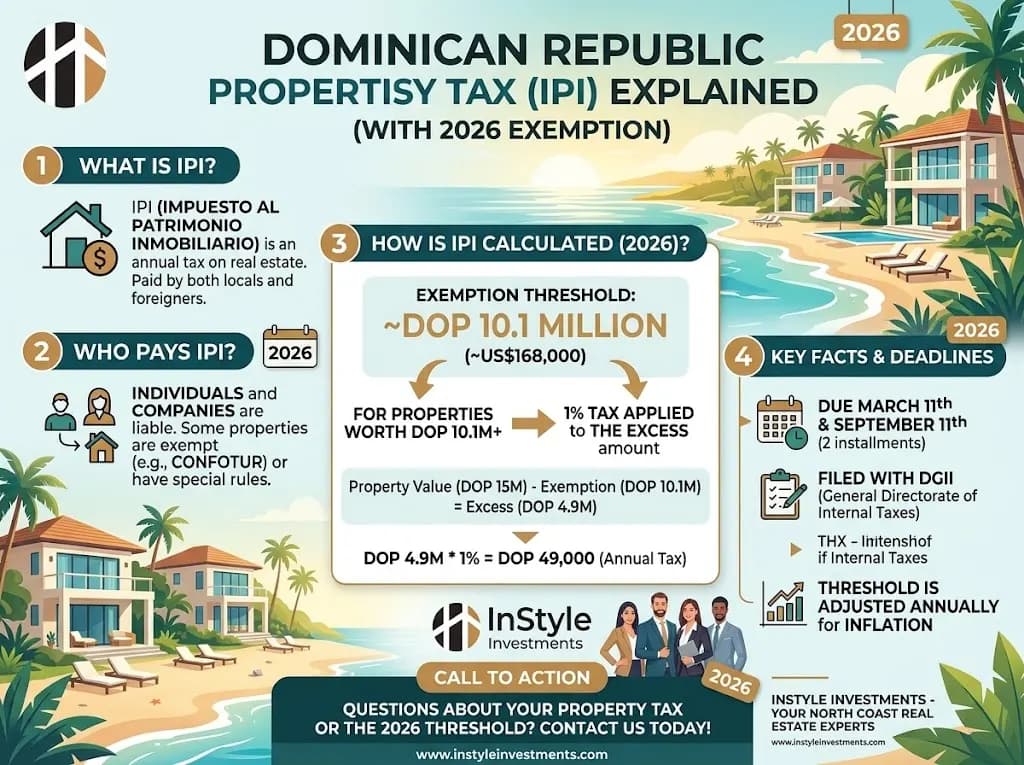
Short answer: The Dominican Republic's annual property tax, the IPI, is 1% per year, but only on the value of your combined Dominican real estate above an exempt threshold. For 2026 that threshold is RD$10,695,494, roughly US$181,000 at about 59 pesos per dollar. A single property below that value owes no IPI.
What is the IPI property tax in the Dominican Republic?
The IPI, or Impuesto al Patrimonio Inmobiliario, is a yearly tax on the real estate an individual owns. It is not a tax on every dollar of value. The DGII, the Dominican tax authority, sets an exempt amount each year, and the 1% rate applies only to the portion above it.
The formula is short:
(total value of all your Dominican real estate − exempt amount) × 1% = IPI due
Two words in that sentence do the heavy lifting. "Total" means the threshold is applied once to everything you own in the country, not once per property. "Individual" means the rule is different when a company owns the property, as explained further down.
Law 30-26, the tax reform in force since June 18, 2026, did not change the IPI, according to Navetta Properties. The reform is mostly relevant here through the sale side; see our article on capital gains tax on Dominican Republic property.
What is the IPI exemption amount for 2026?
For 2026 the DGII set the exempt amount at RD$10,695,494. That is 4.95% above the 2025 figure of RD$10,190,833, an increase of about RD$504,661. The amount is adjusted every year, so the number in this article applies to 2026 only. Check the DGII's published figure each January.
Converting to dollars takes a snapshot of the exchange rate. At the central bank's mid-September 2026 rate of about 59 pesos per US dollar, RD$10,695,494 comes to about US$181,000 (10,695,494 ÷ 59 ≈ 181,280). The peso figure is the legal one. The dollar figure moves with the exchange rate and is only useful for a rough sense of scale.
How do you calculate IPI? Three worked examples
These are illustrations built for this article, using the 2026 threshold and 59 pesos per dollar. Real bills depend on the value the DGII assigns, which can differ from what you paid.
Example 1: a condo valued at US$175,000. US$175,000 × 59 = RD$10,325,000. That is below RD$10,695,494, so the taxable base is zero and the IPI is zero.
Example 2: one condo valued at US$300,000.
- US$300,000 × 59 = RD$17,700,000
- RD$17,700,000 − RD$10,695,494 = RD$7,004,506 above the threshold
- 1% of RD$7,004,506 = RD$70,045, or about US$1,187 per year
Example 3: a villa valued at US$450,000.
- US$450,000 × 59 = RD$26,550,000
- RD$26,550,000 − RD$10,695,494 = RD$15,854,506
- 1% = RD$158,545, or about US$2,687 per year
A higher-value property pays 1% only on the excess, never on the full price. And because the threshold applies to your combined holdings, two condos each valued at US$150,000 together equal Example 2: RD$17,700,000 in total, the same RD$70,045 bill. If you hold property jointly with a spouse or partner, ask your attorney how the threshold is applied; the sources we reviewed do not cover it.
DRListings, a property portal, offers a similar example in dollars: a US$300,000 condo, with the DGII value matching the market, leaves about US$118,000 above the threshold and an annual bill of about US$1,180. The small gap against Example 2 is rounding and a slightly different exchange rate.
What value does the DGII use?
The DGII values property itself and does not simply take your purchase price. DRListings reports that assessments are issued annually from the property valuations in the DGII's system, and that you can view yours in the DGII's online portal once your taxpayer profile is linked. The same logic applies to the transfer tax, which uses the higher of price and DGII value. Before you buy, ask your attorney what the DGII value is. If it sits far above your price, it is the number that counts for tax.
When is IPI due, and what happens if you pay late?
The annual declaration falls in the first 60 days of the calendar year. Payment is split into two equal installments:
- First installment: by March 11
- Second installment: by September 11
One guide reports that a missed deadline brings a 10% surcharge plus monthly interest, and that continued non-payment can result in a lien on the property title that blocks sales or refinancing until it is cleared. We found this in one source, so ask your attorney to confirm the current penalties. The practical point stands regardless: an unpaid IPI is the kind of problem that surfaces at the worst moment, when you try to sell.
Since the second installment falls on September 11, the 2026 installment dates have passed as of this writing. The next cycle starts with the 2027 declaration and the 2027 threshold.
Who is exempt from IPI?
Four groups are named in the sources:
- A sole home owned by an individual aged 65 or older is fully exempt.
- Rural land used for agriculture is exempt.
- Properties inside an active CONFOTUR (Law 158-01) exemption window are exempt. Our article on CONFOTUR tax benefits explains how narrowly this applies on the north coast.
- Foreign retirees with Pensionado or Rentista residency under Law 171-07 get a 50% reduction on their qualifying property. The program requires verifiable income of at least US$1,500 a month in pension or US$2,000 a month in passive income, per the Pellerano & Herrera summary. See how to get Dominican Republic residency.
Is it cheaper to own through a company or in your own name?
For one moderately priced vacation property, usually your own name. A property held by a Dominican company (an SRL) does not pay IPI. The company instead owes a 1% asset tax on the property's full value, with no exempt threshold, or its income tax if that is higher, according to Arthur & Castillo and DRListings.
Run it on Example 2. Personally owned, the US$300,000 condo costs about US$1,187 a year in IPI. In a company, 1% of the full RD$17,700,000 is RD$177,000, about US$3,000, with no threshold to shelter the first US$181,000. A company can still make sense for other reasons such as liability or estate planning, but the annual tax is not the argument for it. That decision needs a Dominican attorney, since it also changes the capital gains position when you sell.
What does IPI mean for buyers on the north coast?
It means budgeting differently by price band. Smaller condos valued below the threshold carry no IPI at all. Villas and larger holdings carry 1% on the excess, which for most of the examples above is a four-figure dollar amount per year, small next to a purchase price but worth putting in the cost of ownership. The same logic applies to land: your total across all properties is what counts.
To see what is currently available, browse the listings or filter by condos and apartments and houses. The one-off costs at purchase are in our guide to closing costs.
Frequently asked questions
What is the IPI rate in the Dominican Republic? 1% per year, charged only on the value of your combined real estate above the annual exempt amount. For 2026 that amount is RD$10,695,494.
Do I pay IPI if my property is worth less than the threshold? No. If your total Dominican real estate is valued below the exempt amount, the taxable base is zero. This is why a single condo valued around or below US$181,000 may owe nothing.
When do I pay IPI? Declare in the first 60 days of the year and pay in two installments, by March 11 and September 11.
Does IPI apply to foreign owners? The sources describe IPI as a tax on individual owners of Dominican property without a separate rule for foreigners. Foreign Pensionado and Rentista residents get a 50% reduction.
Will the exempt amount stay the same next year? No. The DGII resets it annually. It rose from RD$10,190,833 in 2025 to RD$10,695,494 in 2026, so expect a new figure for 2027 and check it in January.
This article is general information, not legal or tax advice. A Dominican attorney or accountant should review how IPI applies to your holdings.
Sources
- El Inmobiliario, "DGII fija nuevo monto para el pago del IPI en el 2026": https://inmobiliario.do/dgii-fija-nuevo-monto-para-el-pago-del-ipi-en-el-2026/
- CLIC Inmobiliaria, "Real Estate Taxes in the Dominican Republic 2026": https://clicinmobiliaria.com/en/articles/guia-inmobiliaria/impuestos-inmobiliarios-rd-2026-ipi-transferencia-guia
- Listín Diario, "DGII actualiza montos de viviendas de bajo costo" (January 2026): https://listindiario.com/economia/20260117/dgii-actualiza-montos-viviendas-costo_890191.html
- Alegra, "Guía para calcular y pagar el IPI": https://blog.alegra.com/republica-dominicana/ipi/
- DRListings, "Dominican Republic Property Taxes: 2026 Owner's Guide": https://www.drlistings.com/blog/dominican-republic-property-taxes/
- Arthur & Castillo Lawyers, "Dominican Real Estate Property Tax": https://aclaw.com/dominican-real-estate-property-tax/
- Pellerano & Herrera, "Pensionado o Rentista bajo la Ley 171-07": https://phlaw.com/es/pensionado-o-rentista-bajo-la-ley-171-07/
- Infobae, USD/DOP exchange rate, September 16, 2026: https://www.infobae.com/noticias/2026/09/16/precio-del-dolar-hoy-en-republica-dominicana-cotizacion-de-cierre-del-16-de-septiembre/
- Navetta Properties, "Law 30-26 and capital gains on property sales" (IPI unchanged): https://www.navettaproperties.com/blog/law-30-26-capital-gains-property-sales
- El Inmobiliario, "Guía: cuánto paga en impuestos quien compra, construye o alquila un inmueble": https://inmobiliario.do/guia-cuanto-paga-en-impuestos-quien-compra-construye-o-alquila-un-inmueble-en-republica-dominicana/
Last reviewed: October 1, 2026
 Verfasst vonJustian HankeDigital Sales Executive