

How to Sell Property on the Dominican Republic's North Coast
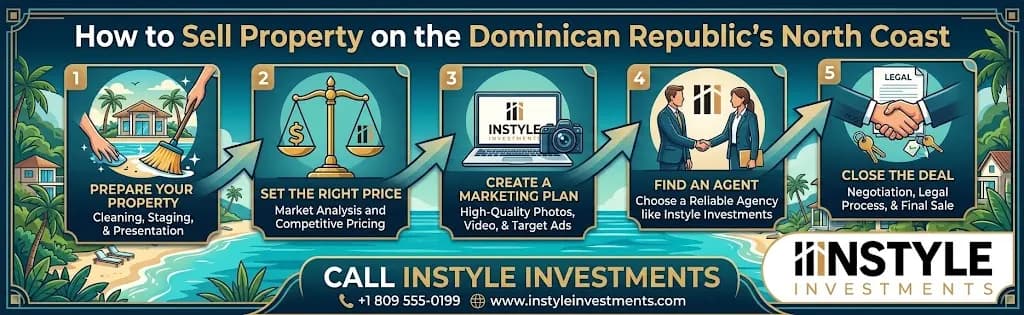
Short answer: Selling in Sosúa, Cabarete or Puerto Plata comes down to four things: a price based on comparable asking prices rather than hope, a clean set of documents (title, survey, tax certificate, condominium papers), a property that is easy to view, and a closing that runs through a notary, the tax office and the title registry. The seller normally pays the agent's commission of 3% to 6%.
This guide covers the sale itself. Taxes on the gain get a short section and a link, because the rules changed in 2026. It is general information; a Dominican attorney reviews your documents and your case.
How do you price a property for sale on the north coast?
Start from comparable asking prices, then adjust for what is specific to your property. Be careful with the word "asking": the broker data available is asking prices, not closing prices. CENTURY 21 Perdomo's September 2026 price review, for instance, states plainly that its figures are asking prices and indicative estimates (CENTURY 21 Perdomo).
| Town | Median asking price per m² (apartments) | Median apartment price |
|---|---|---|
| Cabarete | US$2,641 | US$285,000 |
| Sosúa | US$2,083 | US$175,000 |
| Puerto Plata | US$2,025 | US$197,885 |
Source: CENTURY 21 Perdomo, September 8, 2026. These are one broker's figures, based on its own inventory; the firm itself notes that its entry-level listings differ from the medians. Cross-check against several sources and use the numbers as a range, not as your price.
Worked example (illustration only): a 100 m² apartment in Sosúa. At the table's median of US$2,083 per m², the benchmark is 100 × 2,083 = US$208,300. That is a starting point. Then compare against three to five similar listings in the same building or street, and adjust for floor, view, distance to the beach, condition and what is included. The numbers above are not a valuation.
Three adjustments tend to matter more than sellers expect:
- Location inside the town. Compare like with like: beachfront, gated-community and inland units are different groups. Instyle's Sosúa Ocean Village and Casa Linda pages show what is on offer inside two communities.
- Who the likely buyer is. Broker sites describe Sosúa as drawing retirees and second-home buyers, Cabarete a younger, water-sports crowd, and Puerto Plata first-time buyers and investors. This is a pattern from broker sites, not official data, but it shapes how you present the property. Our comparison of Sosúa, Cabarete and Puerto Plata goes deeper.
- Clean paperwork. A property with a complete document set can be priced with confidence. One with gaps invites a discount, or a stalled deal.
Instyle offers a free valuation on its sell-my-property page, a practical way to check your own numbers against what buyers are actually looking at.
Which documents does a seller need?
Gather these before you list. Guzmán Ariza, a leading Dominican law firm, names the documents a buyer's attorney will ask the seller for (Guzmán Ariza):
- Copy of the certificado de título for the property.
- Copy of the official survey or plat plan (the deslinde). Without a government-approved plot, a sale generally cannot be recorded at the registry, with narrow exceptions.
- Identification (cédula or passport) of the seller and, if married, the spouse. Both spouses usually have to sign, even if only one is named on the title (DRListings).
- The last property tax (IPI) receipt, or a certificate that the property is exempt, plus a certification from the tax office (DGII) that the seller is current on tax obligations.
- If the seller is a company: corporate documents, current commercial registration, a resolution authorizing the sale, and a DGII certification that the company is current on income tax and asset tax.
- If it is a condo unit: the condominium declaration and regulations, approved construction plans, a certification from the administration that dues are paid, and minutes of the last three condominium meetings.
- If it is a house: approved construction plans, an inventory of furniture if it is included, and utility contracts with receipts showing the bills are paid.
Expect the buyer's lawyer to also order a current certificación de estado jurídico from the Registro de Títulos. It shows liens, mortgages and court annotations as of today, and two sources say it should be dated within about 30 days of closing (CanaLaw, DRListings). Order your own early. If it shows an old mortgage that was paid but never cancelled, you want to find out before a buyer does.
Guzmán Ariza adds one item sellers forget: if you employed staff at the property, pay their legal severance, otherwise the buyer may become liable for it later, and buyers' lawyers know to ask.
Not sure what a term on this list means? Ask your attorney, or start with our guide to buying property in the Dominican Republic, which shows the same documents from the buyer's side.
How should you prepare for viewings?
Make the property easy to see and easy to believe. Buyers who travel to see property work to a schedule, so a unit that can be shown on short notice is easier to include. Our viewing trip guide describes how buyers plan those days, which tells you what they will look for.
- Utilities and dues current. A buyer's lawyer will check with the power, water and cable providers and, for condos, with the administration.
- Fix what a builder or architect would find anyway. Guzmán Ariza recommends that buyers have a qualified builder or architect inspect the improvements. A leak you repaired is a smaller conversation than a leak the inspector reports.
- Settle tenancy first. The same firm warns buyers that Dominican law protects tenants and that removing a reluctant one is slow and expensive. If the property is tenanted, tell buyers at the start, or sell it vacant.
- Know your boundary and your coastline. On beachfront, the 60-meter coastal strip cannot be owned, so be ready to show where the private title line sits (Guzmán Ariza).
- Photograph and describe it accurately. Use the registered area from the title, not an estimate; the legal area is what the buyer is buying.
What are the steps from accepted offer to closing?
Dominican sales do not run like a North American offer and acceptance. After the price is agreed, the sequence is usually this:
- Promise of sale (promesa de venta). A binding contract signed before a notary. The buyer typically pays a deposit of roughly 10% to 20% of the price (Rightmove Overseas). DRListings says it should sit with an independent trust account, an escrow company or a developer fideicomiso rather than with the seller (DRListings).
- Due diligence. The buyer's attorney checks title, liens, survey, tax standing and, for condos, the dues.
- Deed of sale (contrato de venta). Signed by both sides before a notary; the balance is paid around this point.
- Tax appraisal and transfer tax. The deed goes to the DGII, which appraises the property. The buyer pays the 3% transfer tax within six months of the deed.
- Registry. The deed, tax proof and your original title go to the Registro de Títulos, which issues a new title in the buyer's name. Ownership passes when the sale is recorded, and the registry step can take a few days to a few months (Guzmán Ariza).
Sources give a total of roughly 45 to 90 days from promise of sale to title in the buyer's hand (Rightmove Overseas, Century 21 Perdomo), and one source gives 60 to 120 days from accepted offer (DRListings). The registry step is the least predictable. Once the escrow releases the price, a SWIFT wire to a Dominican bank takes one to three business days per DRListings.
Who pays what when you sell?
| Item | Who normally pays | Notes |
|---|---|---|
| Agent's commission | Seller | Typically 3% to 6% of the sale price; confirm in your listing agreement (BuyDRProperty) |
| Transfer tax (ITI) | Buyer | 3% of the higher of price or DGII value |
| Clearing liens, mortgages, unpaid taxes | Seller | Before closing, or accept reduced proceeds (DRListings) |
| Fixing title defects found in due diligence | Typically seller | Per DRListings |
| Tax on the gain | Seller | See next section |
What about tax on the sale?
Briefly: capital gains tax on real estate sold by individuals was cut to 10% of the gain under Law 30-26, in force since June 18, 2026, according to KPMG's tax alert. Older articles quoting 25% are out of date. How the cost basis is computed for long-held property was still unsettled when we reviewed it, and whether any exemption applies to you depends on your residency facts. We explain it in full in our article on capital gains tax on Dominican Republic property. Confirm the figure for your sale with a Dominican attorney or accountant, and with your home-country tax adviser.
Frequently asked questions
How long does it take to sell a property in the Dominican Republic?
There is no published average for the north coast. Once you have a signed promise of sale, sources describe roughly 45 to 90 days to title. How long it takes to find a buyer depends on price, condition and documents, and we have no verified figure for it.
Do I need an attorney to sell?
Dominican sales run through a notary, who must hold a law degree, and the buyer's attorney will examine your papers. Having your own attorney check them first is the practical way to avoid surprises. Ask for a written fee quote.
Who pays the real estate agent when I sell?
By Dominican custom the seller pays, typically 3% to 6% of the price. Check the figure in your listing agreement.
Can I sell if the property is still in my company's name?
Yes, but the buyer's attorney will require corporate documents, a resolution authorizing the sale and DGII tax certifications for the company. Ask your attorney how the company's tax position affects the sale.
What if my property has no survey?
Without a government-approved plot a sale generally cannot be recorded, with narrow exceptions. Ask your attorney whether a deslinde has to be arranged; that adds time and cost.
Sources
- CENTURY 21 Perdomo, "Property Prices by Area" (September 8, 2026): https://c21perdomo.com/blog/property-prices-cabarete-sosua-puerto-plata/
- Guzmán Ariza, "Buying Real Estate in the Dominican Republic": https://drlawyer.com/buying-real-estate-in-the-dominican-republic/
- DRListings, "Dominican Republic Property Closing Process": https://www.drlistings.com/blog/dominican-republic-property-closing-process/
- DRListings, "Dominican Republic Property Due Diligence": https://www.drlistings.com/blog/dominican-republic-property-due-diligence/
- CanaLaw, "Property Title Problems in DR Real Estate" (April 2026): https://cana.law/blog/property-title-problems-dominican-republic-foreign-buyers/
- Rightmove Overseas, "Legal Advice - Buying Overseas - Dominican Republic": https://www.rightmove.co.uk/overseas-magazine/legal-advice-buying-overseas/dominican-republic/
- Century 21 Perdomo, "Buying Property in the Dominican Republic: 8 Steps": https://c21perdomo.com/blog/buying-property-dominican-republic-foreign-buyers/
- BuyDRProperty, "Dominican Republic Closing Costs, Property Tax & CONFOTUR": https://buydrproperty.com/dominican-republic-closing-costs-taxes-a-foreign-investors-guide/
- KPMG, "Dominican Republic: Changes to tax code concerning income tax, real estate, inheritance and gift tax" (July 2026): https://kpmg.com/us/en/taxnewsflash/news/2026/07/dominican-republic-tax-code-changes.html
- Instyle Investments, "Sell Your Property in Sosúa & Cabarete": https://instyleinvestments.com/sell-my-property-dominican-republic
Last reviewed: October 1, 2026
 Verfasst vonAlexander MaurerbauerCEO (Chief Executive Officer)
Weiterlesen
- Leben in Sosúa: Ortsführer und 136 Immobilien
- Leben in Cabarete: Ortsführer und 27 Immobilien
- Leben in Puerto Plata: Ortsführer und 5 Immobilien
- Leben in Sosua Ocean Village: Ortsführer und 14 Immobilien
- Leben in Casa Linda: Ortsführer und 6 Immobilien
- Immobilienkauf in der Dominikanischen RepublikKaufnebenkosten, Grundsteuer, CONFOTUR und der Kaufablauf
- Padel in Sosúa, Cabarete und Puerto Plata: Die besten Clubs, Plätze und PreiseJournal
- Price per Square Meter in Sosúa and Cabarete: What Instyle's Listings ShowJournal