

Does Buying Property Give You Residency in the Dominican Republic?
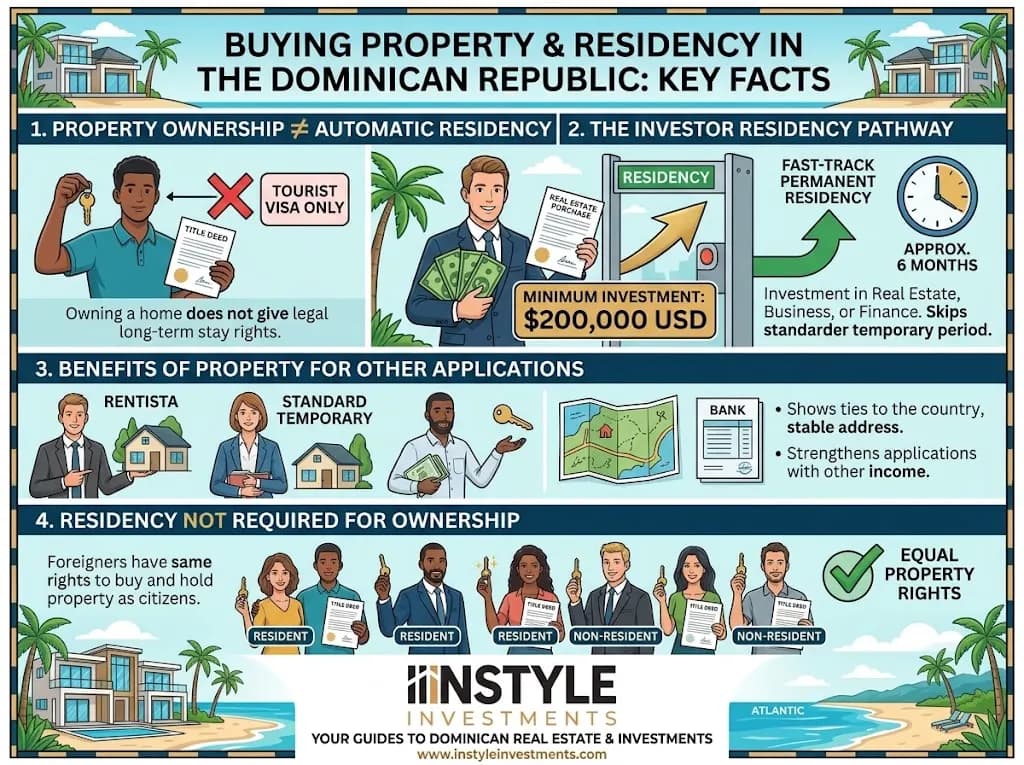
Short answer: No. Owning property in the Dominican Republic gives you ownership rights, not immigration status. US and Canadian citizens enter visa-free as tourists for 30 days, with extensions possible up to 120 days. To live in the country longer you need a residence category, and the investor route requires at least US$200,000 of certified foreign investment plus a separate application.
General information, not legal or immigration advice. A Dominican immigration attorney should confirm the current rules for your situation.
What does owning property actually give you?
Title, and nothing about your right to stay. Foreigners have the same property rights as Dominican citizens, with no residency requirement, no local partner and no special permit to hold title, according to the Dominican legal sources behind our buying guide. A foreigner can own a house in Cabarete for decades and still be a tourist at the airport.
That cuts both ways. You can buy before you move, and you do not need residency to hold title. It also means the closing and the immigration process are two separate tracks. Our buying guide covers the first. This article covers the second.
How long can a tourist stay?
For US and Canadian citizens, visa-free entry for tourism is allowed for up to 30 days, and the stay can be extended for a fee, up to a maximum of 120 days in total. That figure comes from a general reference summary of the visa policy. The extension is requested from the immigration authority (DGM). The exact deadline for asking, the fees and the process change, so check the DGM before you rely on them.
Entry also involves a fee. A reference source states that since April 2018 the tourist card is no longer required by air and the fee is charged with the airfare for tickets issued outside the country. Check your own ticket and the current rules.
Anyone who plans to remain longer than the extension should expect to need a resident status. What happens if you stay past the permitted period is not something I verified, so ask before you test it.
What are the residency categories in the Dominican Republic?
The migration law distinguishes residents and non-residents, and the DGM issues several resident categories. This table summarizes what an immigration guide by El Inmobiliario lists, with the duration it reports.
| Category | Duration reported | Who it is for |
|---|---|---|
| Tourist (non-resident) | 30 days, extendable to 120 total | Visitors |
| Temporary, general (RT-9) | 1 year, renewable | General intent to reside |
| Temporary, labor (RT-3) | 1 year, renewable | Employment contract with a Dominican company |
| Temporary, dependent (RT-7) | 1 year, renewable | Spouse or minor children of a resident |
| Retiree or rentista | Described either as permanent or as 1 year renewable, sources differ | Foreign pension of US$1,500 per month or stable income of US$2,000 per month |
| Investor | Described as direct permanent residence in most sources | At least US$200,000 certified foreign investment |
| Permanent | 4 years, renewable | After five or more years of continuous temporary residence |
| Definitive | Indefinite | After ten or more years of continuous permanent residence |
Treat this as an orientation table, not a checklist. The same guide notes that the process in most cases begins abroad, where you request a residence visa at a Dominican consulate before traveling with the intention to reside. Document requirements include an apostilled birth certificate, police clearance and a medical exam at an authorized facility.
Which route fits a property buyer?
Three routes come up, and they work differently.
Investor residency. The program describes a minimum of US$200,000, foreign capital, certified by ProDominicana, in property or other qualifying investments. The property purchase supplies the investment. The application and certificate still have to be done. A separate article on residency by property investment walks through the steps and the points where sources disagree.
Retiree or rentista. Law 171-07 sets the thresholds of US$1,500 per month for pensions and US$2,000 per month for other foreign income, plus US$250 per dependent. It does not require you to buy property, but it adds tax benefits if you do, including a transfer tax exemption on the first property and a 50% reduction in IPI while the permit is valid. A separate article on the retiree program covers the details and the open questions after the 2026 tax reform.
Temporary residency by a general application. This is the ordinary one-year route for people who do not fit the others. The El Inmobiliario guide reports roughly 90 business days and a RD$14,000 deposit plus medical exam costs for the general category. Your attorney will know the current fees.
For a comparison of all categories in one place, see our article on how to get Dominican Republic residency.
What does property ownership alone not do?
A short list, so nobody learns it the hard way.
- It does not extend your tourist stay. Owning a home does not change the 30 days plus extension.
- It does not create a right to a residence visa. You still apply, and the investor route has its own certificate.
- A purchase below US$200,000 does not meet the investor threshold on any source I found.
- It does not give citizenship. One law-firm guide states the country offers no direct citizenship by investment.
- It does not by itself settle your tax position at home. Tax residency in the US or Canada is a separate matter with a separate adviser.
- It does not remove Dominican property taxes. The 3% transfer tax at purchase and IPI above the annual threshold still apply unless a specific incentive covers you. See the cost of owning property in the Dominican Republic.
Many buyers never need residency at all. People who spend a few months a year in the country, rent the property out, or use it as a second home often manage as tourists. Others, especially full-time retirees, find the resident categories worth the paperwork.
How do you decide?
Start with how many days a year you plan to be in the country. If the answer is under a few weeks, the tourist status plus extensions is simple. If it is several months every year, ask an immigration attorney which category fits and what it would cost. If you plan to live in the country, the question is which category and when to start, since the process begins abroad and takes weeks to months.
If you are still choosing where, our comparison of Sosúa, Cabarete and Puerto Plata helps.
Frequently asked questions
Do I need residency to buy property in the Dominican Republic? No. Foreigners can buy and hold title on the same terms as Dominicans, without residency, a local partner or a special permit. Residency is a separate matter.
Can I get residency if I buy a US$150,000 condo? Not through the investor route as the sources describe it, since the threshold is US$200,000 of certified foreign investment. Other routes, such as retiree or general temporary residency, depend on your own circumstances rather than the property.
How long can I stay in the Dominican Republic as a tourist after buying? For US and Canadian citizens, 30 days on entry, extendable to a maximum of 120 days through the immigration authority for a fee. Confirm the current extension rules and costs with the DGM.
Is investor residency permanent? Most guides call it direct permanent residency, but one lists it as one year renewable, and another describes a first card valid for one year and then renewable in four-year periods. Ask an attorney how the DGM treats it today.
Do I have to start the residency process before buying? Not necessarily, but for the investor route you need proof that the funds came from abroad and a ProDominicana certificate tied to the investment, so planning before you pay helps. An attorney can map the order.
Next step
Write down how many days a year you expect to spend in the country and send that number to an immigration attorney before you decide whether residency is worth pursuing. If you are ready to look at homes, contact Instyle or browse current listings.
Sources
- Wikipedia, "Visa policy of the Dominican Republic" (30-day stay, 120-day extension, tourist fee): https://en.wikipedia.org/wiki/Visa_policy_of_the_Dominican_Republic
- El Inmobiliario, "Guía práctica para legalizarse en República Dominicana": https://inmobiliario.do/guia-practica-para-legalizarse-en-republica-dominicana-requisitos-pasos-y-tipos-de-residencia/
- Fc Abogados, "Cómo obtener la ciudadanía o residencia dominicana a través de inversiones inmobiliarias": https://fc-abogados.com/en/como-obtener-la-ciudadania-o-residencia-dominicana-a-traves-de-inversiones-inmobiliarias/
- Mackrell International, "Dominican Republic Golden Visa": https://www.mackrell.net/goldenvisa/dominican-republic
- Ley 171-07 (text with articles): https://drlawyer.com/espanol/leyes/ley-171-07-sobre-incentivos-especiales-a-los-pensionados-y-rentistas-de-fuente-extranjera/
- Guzmán Ariza, "Introduction to the legal framework" (foreign ownership rights): https://drlawyer.com/introduction-to-the-legal-framework/
Last reviewed: October 1, 2026
 Written byJustian HankeDigital Sales Executive
Keep reading
- Living in Sosúa: area guide and 106 properties
- Living in Cabarete: area guide and 29 properties
- Living in Puerto Plata: area guide and 5 properties
- Buying property in the Dominican RepublicClosing costs, property tax, CONFOTUR and the buying process
- Padel Tennis in Sosúa, Cabarete & Puerto Plata: Best Clubs, Courts & PricesJournal
- CONFOTUR in Sosúa & Cabarete: Wie Sie beim Immobilienkauf bis zu 15 Jahre Steuern sparen (Leitfaden 2026)Journal