

Beach Access in the Dominican Republic: What Property Owners Can and Cannot Do
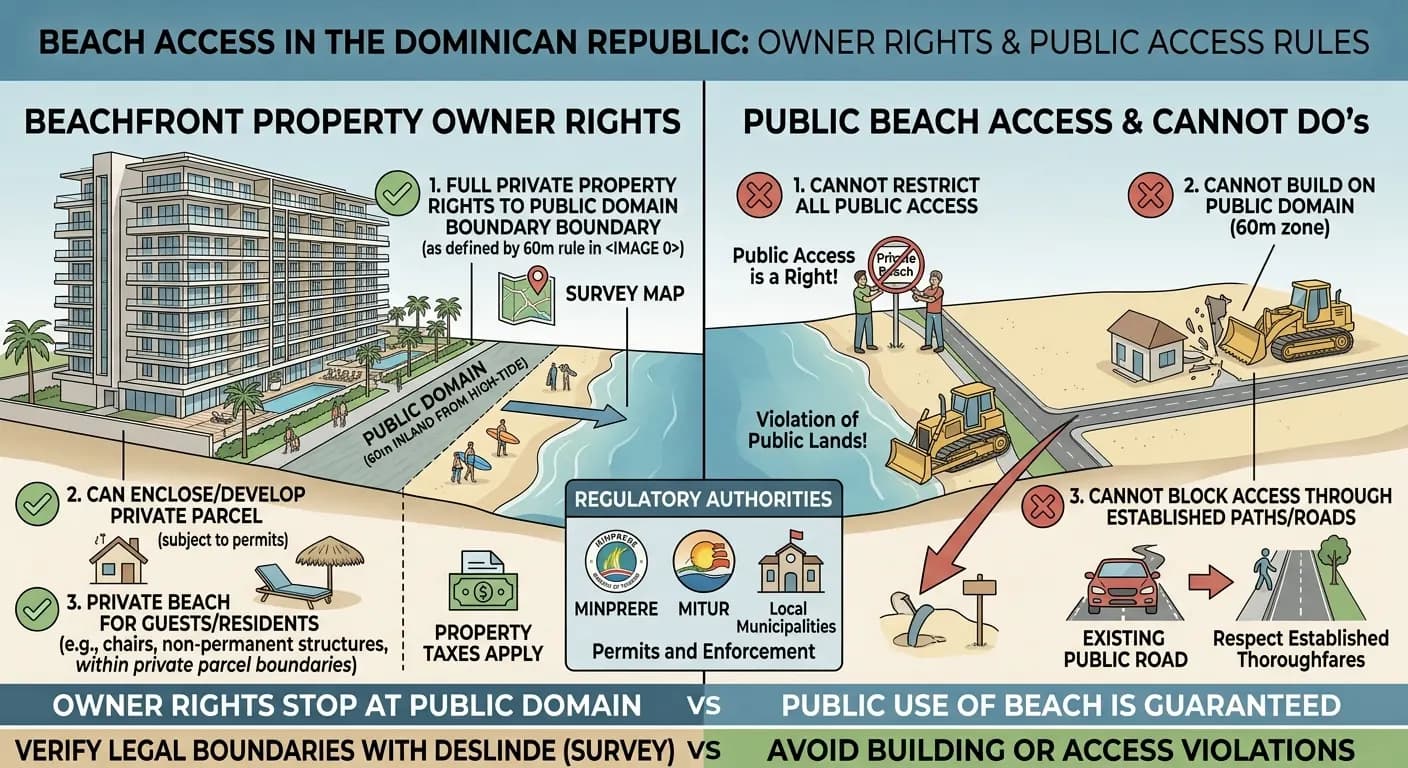
Short answer: Every beach in the Dominican Republic is public domain, and the first 60 metres inland from the high-tide line cannot be sold or blocked. Owning the land behind a beach gives you a building plot, not control of the sand. A buyer should therefore ask how people actually reach the beach, what stands inside the 60 metres, and whether anyone is allowed to build there.
Most articles on the 60-metre rule stop at "you cannot own the beach." The harder questions come after the purchase: can you gate your path, can a community call its beach private, and what happens to a terrace or restaurant built too close to the water?
What does the law say about public beach access?
Article 15 of the Dominican Constitution places rivers, lakes, beaches and national coastlines in the public domain and makes them freely accessible, while respecting adjacent private property rights. Law 305 of 1968 created the 60-metre strip, measured inland from the high-tide line along every coast. Construction inside it is prohibited as a general rule, with exceptions the executive branch can authorize for tourism or public-utility projects. The Environment Ministry describes the purpose of the strip as protecting ecological integrity and coastal scenery and ensuring public access to beaches.
The General Environmental Law 64-00 (Articles 145 to 147) classes these areas as inalienable, imprescriptible and unseizable. In plain terms: they cannot be sold, cannot be acquired by long use, and cannot be taken as collateral. Nobody owns them, not a developer, a hotel or a homeowners' association.
One nuance appears in a Dominican real-estate source: rights that existed when the law passed in 1968 were preserved, so some old titles may reach into the strip. Even then, the construction ban applies. Whether a given title qualifies is a question for your attorney.
What did the Constitutional Court decide about blocked access?
In December 2023 the Constitutional Court issued ruling TC/0751/23. According to commentators cited by Dominican and English-language outlets, it held that owners of property next to the coast cannot obstruct access to beaches, shorelines and riverbanks. One source describes the case as a titled owner who had fenced off the public path to Playa Las Canas in Samaná and was ordered to remove the barriers. We read the ruling through these secondary sources, not the judgment itself, so ask your attorney for the text if it matters to your deal.
The practical meaning for a buyer: a gate, wall or chain that closes the only route to a public beach is not protected by your title.
Can a gated community have a private beach?
The sand cannot be private. What a community can control is its own land: roads, gates, pools, clubhouses. The easiest way to see the difference is to read how communities describe themselves.
- Sosúa Ocean Village says on its own site that it has more than 600 metres of coastline. The beach inside the community is open to the public; non-residents need a day pass for the pools and water park. See the community page.
- Sea Horse Ranch describes several miles of "semi-private" beach on the Atlantic. The word "semi-private" is the community's, and given the law it is worth asking exactly what it means: who enters, from where, and under what rules. See the community page.
A travel-law explainer from Mamajuana Travel draws a useful line for hotels that applies equally to communities. Chairs, umbrellas, bars and pools belong to the property and can be restricted. The sand does not. And access must exist as a real entry: if a road toward the water ends at a locked gate, the explainer says that is worth questioning and documenting.
The same piece describes a pattern in 2026. In July a Dominican musician said hotel security stopped him sitting on the sand at Juan Dolio, and the Tourism Ministry announced a working group with the Environment Ministry, the police and the Attorney General's office. In August a broadcaster filed a complaint with the Environment Ministry over Macao Beach in Punta Cana. Both are allegations. As of August 5, 2026 no authority had ruled on either, and the Macao resort had not responded publicly. Neither is on the north coast. They show that disputes over access are being filed and publicized.
What can you build near the 60-metre strip?
Nothing inside it, unless the government has issued an exceptional authorization. Evalúa, a Samaná-based property platform, states that Law 305-68 prohibits all construction in the strip, including provisional structures, and that unauthorized works face court-ordered demolition at the owner's expense.
Enforcement is not theoretical. The Environment Ministry reported an operation at Playa Palmera in Uvero Alto (La Altagracia, on the east coast) in which buildings erected inside the 60 metres were demolished. According to the ministry's announcement, the operators lacked environmental permits and had been notified in 2024 but kept running restaurants and craft shops. The minister said the ministry had run more than 5,000 operations since August 2024. This was the east coast, but the law is national.
For you as a buyer, three things follow:
- Anything at the waterline needs paperwork. A terrace, wall, beach bar or guest cottage close to the water either has the executive authorization or is a demolition risk attached to the property. Ask to see the document.
- Your view is not protected by the strip alone. One broker presents the strip as the legal assurance that the view stays. The strip cannot be built on, except where authorized, but buildings on your side of the line can still rise. Check what the zoning allows in front of you.
- Height limits can apply to the first line. Evalúa cites a tourism-ministry resolution (06/2011) capping buildings at two levels and 7 metres in the first 40 metres of private land in Samaná. We did not verify the same rule for Puerto Plata province, so ask the municipality.
How do you test beach access before you buy?
Do it on foot, in this order:
- Find the public access point nearest to the property. Is it signposted? Is it open every day?
- Walk from the unit to the sand and time it. Note stairs, road crossings, gates, steep paths.
- Check who maintains the route. If it runs through a community or a building, ask in writing whether you, the HOA or the public uses it.
- Stand where the title line is with the surveyed boundary plan. Your attorney should confirm the survey (deslinde) does not run into the strip.
- Ask for the authorizations for any structure near the water.
- Visit at a weekend. A Sosúa broker notes that Dominican families come to the local beaches then, so that is when you see how access works in practice.
The same walk tells you what you are buying: a plot or a unit with a view and a route to the sand, not a private beach.
Frequently asked questions
Can I fence my beachfront lot down to the water? No. You can enclose your own land, but not the public strip or the route to it. The Constitutional Court's 2023 ruling, as reported, required removal of barriers that blocked public access to a beach in Samaná.
Is the beach in front of my condo mine to use alone? No. The sand is public. The building's pool, loungers and grounds are separate and can be restricted. Ask the HOA what the rules are for guests and for non-residents.
Can foreigners buy beachfront property? Yes, with the same property rights as Dominicans. The 60-metre rule applies equally to every owner, so the question is where the title ends, not who the buyer is.
What if a building near the water has no authorization? That is a legal risk attached to the property. Unauthorized works in the strip can face demolition at the owner's expense. Ask your attorney to review the documents before you pay a deposit.
Is the rule enforced on the north coast? We found a published enforcement case on the east coast and none for Sosúa or Cabarete. The law is national. How it is applied locally is a question for a local attorney.
Next step
When you shortlist a property near the water, ask the agent for three documents: the surveyed boundary relative to the high-tide line, the authorization for any structure close to the sand, and written confirmation of the public access route. Browse current listings or contact Instyle for a specific property. See also the guide to buying property in the Dominican Republic and our article on maintaining beachfront property. This is general information, not legal advice; a Dominican attorney reviews title and survey for the actual parcel.
Sources
- Mamajuana Travel, Why Do Dominican Beaches Feel Private When the Law Says They Belong to Everyone? (August 5, 2026): https://mamajuanatravel.com/blog/are-dominican-republic-beaches-public
- Presidencia de la República Dominicana, Ministerio de Medio Ambiente realiza amplio operativo de fiscalización en Uvero Alto: https://presidencia.gob.do/noticias/ministerio-de-medio-ambiente-realiza-amplio-operativo-de-fiscalizacion-en-uvero-alto
- Evalúa, Beachfront Land DR: 60-Metre Maritime Strip (Law 305-68, Law 64-00, TC/0751/23, MITUR Res. 06/2011): https://www.evalua.do/articles/beachfront-land-dominican-republic-60-metre-maritime-strip
- Guzmán Ariza, Introduction to the Legal Framework: https://drlawyer.com/introduction-to-the-legal-framework/
- Sosúa Ocean Village, official site: https://sosuaoceanvillage.com/
- Sea Horse Ranch, official site: https://sea-horse-ranch.com/
- Blue Sail Realty, Playa Chiquita, Sosúa guide (view and the 60-metre zone): https://www.bluesailrealty.com/playa-chiquita-sosua-guide/
- DR1.com forum, 60 meter rule in buying ocean front property: https://dr1.com/forums/threads/60-meter-rule-in-buying-ocean-front-property.119116/page-3
Last reviewed: October 1, 2026
 АвторJustian HankeМенеджер із цифрових продажів
Читати далі
- Життя в Sosúa: путівник районом і 140 об’єктів
- Життя в Cabarete: путівник районом і 29 об’єктів
- Життя в Puerto Plata: путівник районом і 5 об’єктів
- Життя в Sosua Ocean Village: путівник районом і 14 об’єктів
- Життя в Sea Horse Ranch: путівник районом і 10 об’єктів
- Купівля нерухомості в Домініканській РеспубліціВитрати на оформлення угоди, податок на нерухомість, CONFOTUR і процес купівлі
- Best Gated Communities in Sosúa & Cabarete – 2026 GuideЖурнал
- Путівник по Sosúa Ocean Village (2026): будинки, ціни, внески на обслуговування та спосіб життяЖурнал