

Can You Buy Property in the Dominican Republic Without Visiting?
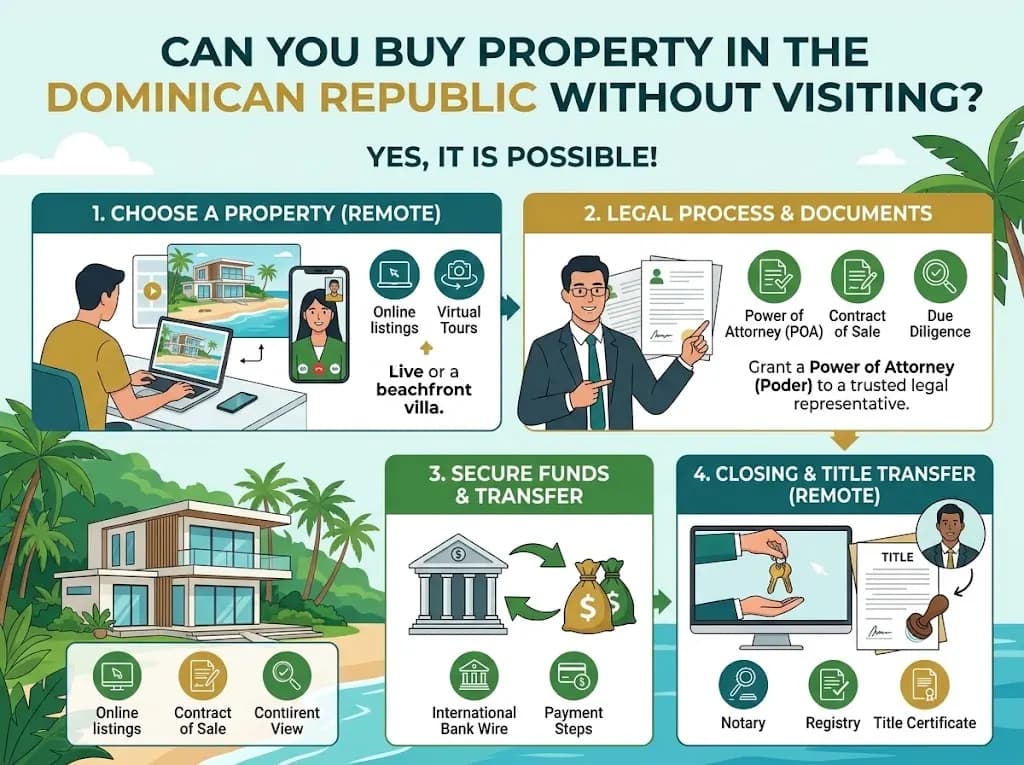
Short answer: Yes. Dominican law does not require a buyer to be present: a notarized power of attorney, legalized for use in the country, lets your Dominican attorney sign the contracts and handle the registry for you. What the law allows and what is wise are different questions. Without a visit, nobody checks the building, the street or the neighbors for you unless you arrange it.
Is a visit legally required to buy in the Dominican Republic?
No. A foreign buyer has the same ownership rights as a Dominican citizen, with no residency requirement, and the only identity document normally needed to hold title is a valid passport [1][2]. Many buyers do sign in person, on an ordinary tourist visa, but a signature by an attorney acting under power of attorney is a recognized route. A broker guide dated August 27, 2026 describes a remote purchase as a sequence: choose the property through video calls and tours, reserve it with a deposit, run the legal due diligence without anyone being present, sign the contract through the power of attorney, pay by international transfer, and have the lawyer handle the title transfer so that a new certificate is issued in your name [3].
That sequence works on paper. The risks below are about what it leaves out.
How does a power of attorney work for a property purchase?
A power of attorney (poder) authorizes a named person, usually your Dominican attorney, to sign on your behalf. The document has to be formally valid in the Dominican Republic, and the rules depend on where you sign it.
According to a Dominican law firm, a power of attorney must be a notarial act, or a private document legalized by a notary public and the attorney general [4]. If you sign abroad, there are two broad routes:
- Notarial act before a Dominican consulate. You appear at the consulate and sign there [4].
- Private document, legalized step by step. A local notary and the competent authority (the attorney general or county clerk, depending on your country) legalize it, followed by the Dominican consulate and the Dominican foreign ministry [4].
If your country is a party to the 1961 Hague Apostille Convention, the same law firm says you may use an apostille in place of the chain of legalizations, which reduces the steps [4]. Ask the attorney which route applies to your country and how long it takes.
Two further requirements trip people up. A document in a language other than Spanish must be translated into Spanish by an authorized judicial interpreter before it can be filed with the registry [4]. And the document has to contain your full name, identification, civil status and domicile, plus a full description of the Dominican property [4].
The August 2026 broker guide adds a warning that applies to every buyer: the power must be specific and limited, and you should never sign a generic, unlimited one [3]. A power that names the property and the purpose does the job. Anything broader hands over more than the purchase needs.
What can happen remotely, and what cannot?
Most of the paperwork can happen without you. The physical checks cannot.
| Step | Can be done remotely? | Note |
|---|---|---|
| Browsing and shortlisting | Yes | Video tours, photos, floor plans |
| Hiring an independent attorney | Yes | Your own, not the seller's [5] |
| Title search and lien check | Yes | Documentary work at the Registro de Títulos [3] |
| Reservation deposit | Yes | By international transfer [3] |
| Promise of sale | Yes, with a power of attorney | Fixes price, schedule and timeline; usually 10% to 20% deposit [6] |
| Boundary survey (deslinde) | Needs someone on site | A surveyor visits the land |
| Condition inspection | Needs someone on site | Building, roof, plumbing, electrical |
| Deed of sale before a notary | Yes, through the attorney | |
| Registry and new title | Yes, through the attorney | Often 45 to 90 days from promise to title [6][7] |
| Final walkthrough and handover | Can be delegated | A third party with a photo report [3] |
The same broker guide notes that most remote buyers still travel for the final inspection [3]. That is a description, not a rule, and no source we found says what share of buyers do so.
What are the real risks of buying unseen?
The biggest risks are physical and structural, not legal. Four recur in the sources and in practice.
You rely on someone else's eyes. Humidity and salt air affect electrical fittings, air conditioners and metal hardware, and photographs rarely show it. Our guide to maintaining beachfront property lists what to look for, and that list belongs in an inspection brief for whoever visits for you.
You depend on the professionals you hire. A Dominican law firm points out that real estate brokers face minimal regulation, since they need no license, and that their obligations are close to non-existent, which creates a potential conflict of interest [4]. Hire an attorney who works for you alone, and ask them to confirm the title, any liens and the survey [5].
Payment sequencing. You may be asked to send a reservation deposit and then a larger promise-of-sale payment before you have seen the place. Ask in writing where the money is held and who can release it. If a seller or developer asks you to wire funds to an account you cannot verify, stop and ask your own attorney.
Pre-construction is the riskiest category to buy remotely. Buyers pay in stages for something that does not exist yet, so the questions that matter are the developer's track record, the permits and where the payments sit. The August 2026 guide says to require a trust structure under Law 189-11 for off-plan projects and to verify the developer's credentials [3]. Our pre-construction guide walks through those checks.
Title itself is protected by a registry system. The Certificado de Título proves ownership, not a signed contract [1]. That is why the title search comes before any payment you cannot recover.
This is general information, not legal advice. A Dominican attorney should review your specific purchase and your power of attorney.
Who is a remote purchase suited to, and who should visit first?
A remote purchase fits best when the property is finished, titled and in a community with an administrator, and when you have someone dependable to inspect it. It fits less well when you are buying land, because boundaries and access are physical, or a unit off-plan, for the reasons above. It also fits less well when you have never seen the north coast and are unsure which town suits you. The three main towns differ in character, which we cover in Sosúa, Cabarete and Puerto Plata compared.
If you decide to visit first, a short trip does most of the work. Our viewing trip checklist covers a 5 to 7 day plan. A compromise many buyers consider is a first visit to choose a town and view finished units, then a remote closing by power of attorney. Whether that compromise suits you depends on the property and your comfort level.
How can you reduce the risk if you cannot travel?
Build the checks into the deal instead of trusting the brochure.
- Hire your own attorney first, before you pay anything beyond a refundable reservation.
- Commission an independent inspection of the building, with photos of electrical, plumbing and roof, from someone with no commission at stake.
- Request a live video walk-through, with you directing the camera: the street, the neighbors' buildings, the water pressure, the access road.
- Ask for the condo documents (regulations, fee history, any special assessments) and have the attorney read them [8].
- Keep the power of attorney narrow: the named property, the named purpose [3].
- Arrange handover and keys in writing, including who holds access codes after closing.
For a taste of what to ask, see our buyer FAQ and guide to buying in Sosúa.
Frequently asked questions
Can a foreigner sign the purchase contract from another country? Yes, through a Dominican attorney acting under a legalized power of attorney. The attorney signs the promise of sale and the deed on your behalf [3][4].
Does the power of attorney need to be in Spanish? It must be translated into Spanish by an authorized judicial interpreter before it is filed with the registry if it is written in another language [4].
Can I pay by international transfer? The August 2026 guide says funds travel through a documented international bank transfer [3]. Keep the transfer records, and confirm account details with your attorney before sending anything.
How long does a remote purchase take? Sources give 45 to 90 days from signed promise of sale to title in hand, with the registry step the least predictable [6][7]. A power of attorney from abroad adds time up front.
What if I want someone to inspect for me? Independent inspection is possible and the sources recommend delegated handover with a photographic report [3]. Choose someone with no financial interest in the sale.
Next step
Before you sign anything, ask your own Dominican attorney for a list of the documents they need from you for a power of attorney, including the legalization route for your country and who translates it. To discuss a specific property and arrange a video tour, contact Instyle, or read the buying guide and browse current listings.
Sources
- Guzmán Ariza, "Introduction to the Legal Framework: Ownership of Real Estate": https://drlawyer.com/introduction-to-the-legal-framework/
- Sienna Terrenas, "Legal Guide: Foreign Property Purchase in Dominican Republic": https://www.sienna.do/blog/legal-guide-dominican-republic-property
- CLIC Inmobiliaria, "How to Buy Property in the Dominican Republic Without Traveling: Remote Purchase Guide" (August 27, 2026): https://clicinmobiliaria.com/en/articles/compradores/como-comprar-propiedad-rd-sin-viajar-compra-remota-guia
- Arthur & Castillo, "Buying Real Estate in Dominican Republic": https://aclaw.com/buying-real-estate-in-dominican-republic/
- Guzmán Ariza, "Buying Real Estate in the Dominican Republic" (own independent attorney, title search, step sequence): https://drlawyer.com/buying-real-estate-in-the-dominican-republic/
- Rightmove Overseas, "Legal Advice - Buying Overseas - Dominican Republic": https://www.rightmove.co.uk/overseas-magazine/legal-advice-buying-overseas/dominican-republic/
- Century 21 Perdomo, "Buying Property in the Dominican Republic: 8 Steps": https://c21perdomo.com/blog/buying-property-dominican-republic-foreign-buyers/
- Guzmán Ariza, text of Law 5038 of 1958 on Condominiums: https://drlawyer.com/espanol/leyes/ley-5038-de-1958-sobre-condominios/
Last reviewed: October 1, 2026
Читати далі
- Життя в Sosúa: путівник районом і 135 об’єктів
- Життя в Cabarete: путівник районом і 27 об’єктів
- Життя в Puerto Plata: путівник районом і 5 об’єктів
- Купівля нерухомості в Домініканській РеспубліціВитрати на оформлення угоди, податок на нерухомість, CONFOTUR і процес купівлі
- Price per Square Meter in Sosúa and Cabarete: What Instyle's Listings ShowЖурнал
- Best Gated Communities in Sosúa & Cabarete – 2026 GuideЖурнал