

Closing Costs When Buying Property in the Dominican Republic
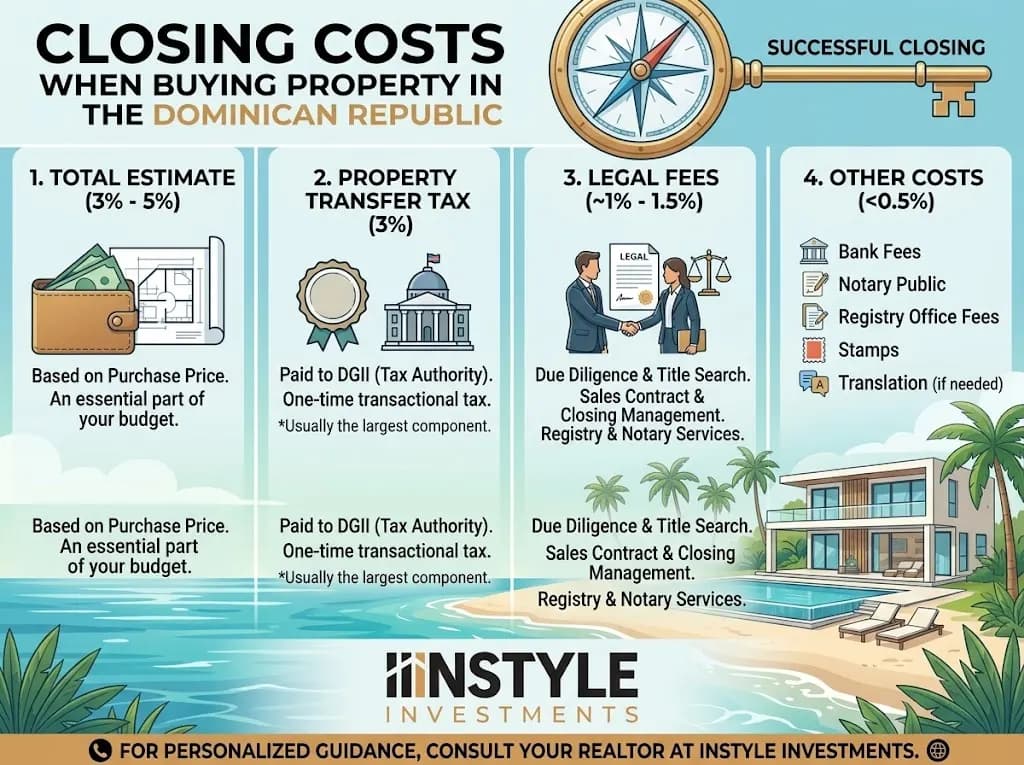
Short answer: On a normal resale purchase, plan for roughly 4% to 6% of the price in one-time closing costs, paid by the buyer. The biggest item is the 3% property transfer tax, followed by attorney and notary fees and a small amount for registration. The seller usually pays the agent's commission. A financed purchase adds a separate mortgage tax.
What are the closing costs when buying property in the Dominican Republic?
Closing costs here are short on line items and heavy on one: the transfer tax. Everything else is fees for the people who make the transaction legal and registered. The table below shows the usual structure for a cash purchase without a CONFOTUR exemption.
| Item | Typical rate | Who pays |
|---|---|---|
| Transfer tax (ITI) | 3% of the contract price or the DGII's assessed value, whichever is higher | Buyer |
| Attorney fee | 1% to 1.5% of the price | Buyer |
| Notary fee | 0.25% to 1% of the price, often already inside the attorney fee | Buyer |
| Registration and administration | about 0.5% (stamps, filing fees, certified copies) | Buyer |
| Survey (deslinde) | varies; often already done for condos | usually Buyer |
| Agent commission | 3% to 6% of the price | Seller, by standard practice |
Sources differ on the top end. Most land on 4% to 6% for a standard purchase, and a few cite up to 9% or 10% for complicated deals. Treat 4% to 6% as the planning figure and expect individual cases to move around it.
How does the 3% transfer tax work?
The transfer tax, formally the Impuesto de Transferencia Inmobiliaria, is 3% of the higher of two numbers: the price in your contract or the value the tax authority (DGII) assigns to the property. The buyer pays it.
The "higher of" rule matters. If you negotiate a price below what the DGII thinks the property is worth, the tax is calculated on the DGII figure. Guzmán Ariza, a large Dominican real-estate law firm, puts the all-in cost of the tax at about 3.1% once small stamps and certified-check fees are included.
Timing is not optional. The tax is due within six months of the date on the notarized deed of sale. After that, a source on transfer tax lists a 10% penalty for the first month, a further 4% for each additional month, and 1.10% compensatory interest per month. In practice buyers pay early, because the Registro de Títulos will not issue the new title until the tax is settled.
What do attorney and notary fees cost?
Budget 1% to 1.5% of the price for your attorney, sometimes with a minimum fee on lower-priced properties and a discount above US$1 million. Notary fees are quoted separately at 0.25% to 1%, but in the Dominican Republic a notary is a licensed attorney, so your lawyer often does both jobs and the fee is not charged twice. Ask which case applies before you sign anything.
This is the line where buyers most often try to save money, and it is usually the wrong place. The attorney's work covers the title search, registry coordination and tax filing, which is the part that protects the rest of your money. Get the fee quote in writing before you sign the Promise of Sale.
A worked example: closing costs on a $350,000 purchase
This is an illustration built from the percentages above, not a quote for any listing. Assume a US$350,000 resale condo, cash purchase, no CONFOTUR, and a contract price that matches the DGII value.
- Transfer tax: 3% of $350,000 = $10,500
- Attorney (notary included): 1% of $350,000 = $3,500, or 1.5% = $5,250
- Registration and administration: about 0.5% = $1,750
Low case: $10,500 + $3,500 + $1,750 = $15,750, or 4.5% of the price. Higher case, attorney at 1.5%: $10,500 + $5,250 + $1,750 = $17,500, or 5.0%.
Now add a separate notary fee. At 0.25% ($875) the higher case becomes $18,375, or about 5.25%. At the 1% end ($3,500) it reaches $21,000, exactly 6%. That is where the 4% to 6% range comes from.
If the DGII had valued the same condo at $400,000, the transfer tax would be 3% of $400,000 = $12,000, which is $1,500 more than the price alone suggests. The deslinde and any extra due-diligence work (an engineer's inspection, for example) come on top and vary by property.
You also need the purchase price itself and a title that is actually clean. Neither is a closing cost, and both are the bigger risk.
Does a mortgage change the closing costs?
Yes. A Dominican mortgage adds the mortgage registration tax, currently 2% of the loan amount under Law 173-07. Law 30-26, the tax reform in force since June 18, 2026, phases it out: it drops to 1% in 2027 and disappears from 2028, according to KPMG.
On a $200,000 loan, that is $4,000 today, $2,000 in 2027 and nothing from 2028. If your closing date sits near a year-end, the timing can matter, so ask your attorney which rate applies on your actual registration date. Do not confuse this tax with the 3% transfer tax: only the mortgage tax is changing. Financing for foreigners has its own rules, covered in our guide to how to finance property in the Dominican Republic.
Can CONFOTUR reduce closing costs?
For the right property, yes. A project with an active CONFOTUR (Law 158-01) exemption waives the 3% transfer tax for the first buyer, which is why such purchases are described as costing roughly 1% to 2% to close. One source puts a CONFOTUR new build at about 2%, or $7,000 on $350,000.
The catch is how narrow this is. The exemption belongs to individually approved projects, not to a town or a neighborhood, and the first buyer gets it, not a later resale buyer. Law 30-26 also introduced a restriction that the trade press says touches the CONFOTUR model. Our article on CONFOTUR and the tax benefits for property buyers explains who qualifies, and new projects are listed under new developments.
How long does closing take, and when is each cost due?
Navetta Properties estimates 45 to 90 days from an accepted offer to the title certificate: one to two weeks of due diligence, one to three weeks for the Promise of Sale and escrow, one to four weeks for the final contract and payment, and 30 to 60 days of registry processing. Your attorney's fee and the transfer tax land mostly in the second half. Escrow is optional but recommended for foreign buyers, for a flat fee or a small percentage. You do not need to be in the country: a power of attorney is accepted.
A short list of what to ask for before you commit:
- A written fee quote from the attorney, stating whether the notary is included.
- The DGII value of the property, so you know the real base for the 3% tax.
- Whether a current survey exists, or a deslinde is needed.
- Whether the listing is in a CONFOTUR-approved project, and the paperwork that proves it.
- The registration date, if you are financing.
Browse current options on Instyle's listings, or start with the buying guide for foreigners. For Sosúa specifically, see buying property in Sosúa.
Frequently asked questions
Do I pay the real estate agent's commission as the buyer? Standard practice here is that the seller pays the agent, usually 3% to 6% of the sale price. Confirm that against the specific listing agreement, but you should not expect a separate buyer's commission on top of your closing costs.
Is the 3% transfer tax calculated on the price I pay? Not always. It is calculated on the higher of the contract price or the DGII's assessed value. A discount negotiated below the assessed value does not lower the tax.
Are closing costs lower for foreigners or higher? The sources do not describe a separate rate for foreign buyers. Foreigners buy under the same rules and the same taxes as Dominican citizens, and the percentages above apply equally.
Do I have to be in the Dominican Republic to close? No. A power of attorney is accepted, and a foreign buyer can also sign while visiting on an ordinary tourist visa. Your attorney can explain what the registry requires in your case.
Can I roll closing costs into my mortgage? According to the Navetta guide, closing costs are not typically rolled into mortgages and are paid in cash. Check this with the lender, since terms differ.
This article is general information, not legal or tax advice. A Dominican attorney should review your specific purchase before you sign.
Sources
- Navetta Properties, "The Total Cost of Buying Property in the Dominican Republic": https://www.navettaproperties.com/blog/closing-costs-dominican-republic
- Guzmán Ariza, "Buying Real Estate in the Dominican Republic": https://drlawyer.com/buying-real-estate-in-the-dominican-republic/
- El Inmobiliario, "Guía: cuánto paga en impuestos quien compra, construye o alquila un inmueble": https://inmobiliario.do/guia-cuanto-paga-en-impuestos-quien-compra-construye-o-alquila-un-inmueble-en-republica-dominicana/
- DGII Help Community, transfer tax exemption discussion (3% on the higher of price or DGII value): https://ayuda.dgii.gov.do/conversations/discusiones/exoneracin-de-3-por-transferencia-inmobiliaria-bajo-costo/68e9cd8d77d577111aae31e0
- 1122 Real Estate, "Tax of transfer real estate in RD" (six-month deadline and penalties): https://1122.com.do/en/blog/impuesto-transferencia-inmobiliaria-rd-calculo-documentos
- TheLatinvestor, "Property Taxes, Fees and Costs in the Dominican Republic (2026)" (notary fee range, up to 9% to 10% on complex deals): https://thelatinvestor.com/blogs/news/dominican-property-taxes-fees
- BuyDRProperty, closing costs guide (seller pays commission, 3% to 6%): https://buydrproperty.com/dominican-republic-closing-costs-taxes-a-foreign-investors-guide/
- Pellerano & Herrera, mortgage tax on second mortgages (2% under Law 173-07): https://phlaw.com/es/exencion-de-impuestos-para-segundas-hipotecas-de-inmuebles-en-republica-dominicana/
- KPMG, "Dominican Republic: Changes to tax code" (July 2026): https://kpmg.com/us/en/taxnewsflash/news/2026/07/dominican-republic-tax-code-changes.html
- Sienna Terrenas, legal guide (title issued in buyer's name, tourist visa): https://www.sienna.do/blog/legal-guide-dominican-republic-property
Last reviewed: October 1, 2026
 Écrit parJustian HankeResponsable des ventes digitales
À lire aussi
- Vivre à Sosúa : guide du secteur et 136 biens
- Acheter un bien immobilier en République dominicaineFrais d’acquisition, taxe foncière, CONFOTUR et déroulement de l’achat
- Price per Square Meter in Sosúa and Cabarete: What Instyle's Listings ShowJournal
- Is Sosúa Safe? An Honest Look for Property BuyersJournal