

Capital Gains Tax on Dominican Republic Property: What Sellers Pay Under Law 30-26
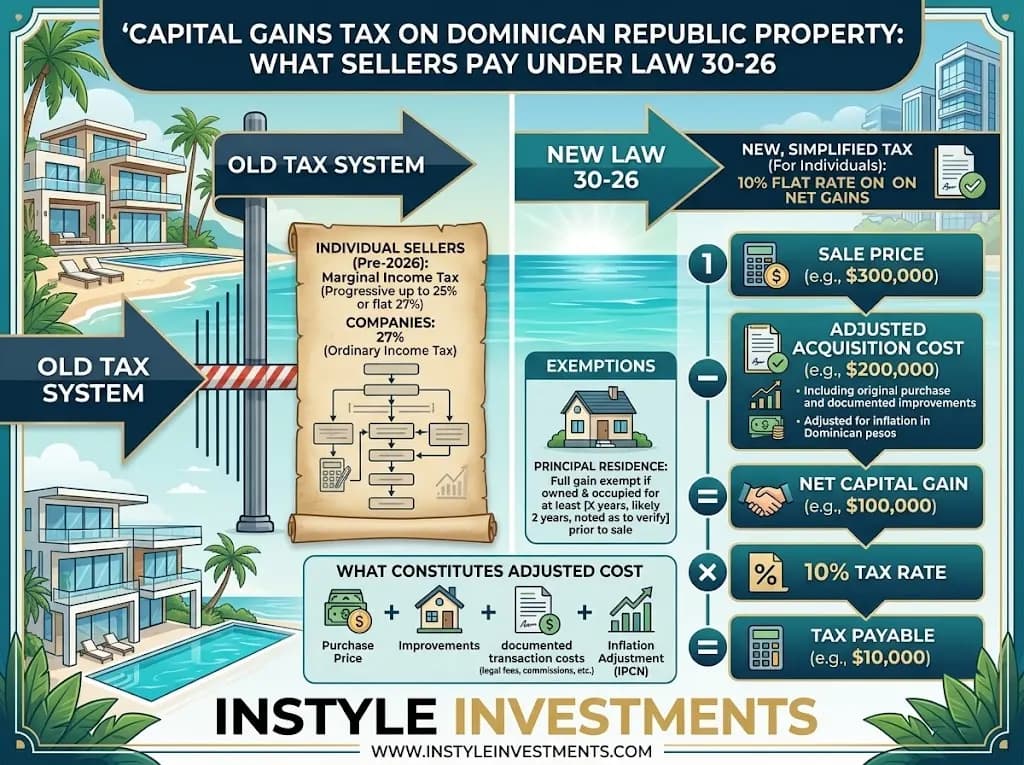
Short answer: Since Law 30-26 took effect on June 18, 2026, an individual who sells Dominican real estate pays a flat 10% on the gain, as a single final payment. The earlier rate that most online sources quote is 25%, so anything older is out of date. The exact way the gain is calculated is still waiting for implementing regulations.
How much is capital gains tax on Dominican Republic property now?
It is 10% of the gain, not of the sale price. Law 30-26, signed on June 18, 2026, added Article 296-1 to the Tax Code and set this rate for real estate sold by individuals as a final, one-off payment. Before the reform, most sources describe the rate as 25%. A few older ones say 27%, which is likely the general corporate rate mixed up with the individual one.
If you read a blog post, a calculator or a broker's PDF dated before mid-2026 that says 25% or 27%, it is describing a regime that no longer applies to individual sellers. Navetta Properties illustrates the difference with a $100,000 gain: $10,000 in tax now, $25,000 before.
Two things did not change. The buyer still pays the 3% transfer tax at closing, and the annual property tax (IPI) is untouched. We cover the second in our guide to the Dominican Republic property tax IPI.
How is the gain calculated?
The gain is the sale price minus your acquisition cost. The cost is meant to include what you paid, documented improvements and acquisition costs, adjusted for inflation under standard Dominican tax rules, according to Siempre al Día. The tax is 10% of what is left.
Their worked example is in pesos: a sale price of RD$8,000,000 and an adjusted cost of RD$5,000,000 leave a gain of RD$3,000,000, so the tax is RD$300,000.
Here is a dollar illustration. It is an example built to show the steps, not a quote for any property, and it assumes the adjusted cost is already known:
- Sale price: $400,000
- Adjusted acquisition cost (price paid, documented improvements, costs, inflation adjustment): $300,000
- Gain: $400,000 minus $300,000 = $100,000
- Tax at 10%: $10,000
- Under the old 25%: $25,000
The assumption in step 2 carries a lot of weight, and the next section explains why.
What is still unclear under Law 30-26?
Quite a lot, and sellers deserve to hear it before they plan around a number. The law set the rate but, according to the Dominican trade outlet El Inmobiliario, left the calculation basis undefined. The Executive Branch has to issue regulations on several points:
- How the taxable base is determined, and whether inflation adjustment under the old code (Article 289) still applies.
- Which documents prove an acquisition cost, which is a real problem for purchases made many years ago with incomplete records.
- How property acquired by inheritance or gift is valued.
- How improvements are deducted.
Siempre al Día adds a further open point: how non-resident sellers are treated. It says the treatment is pending clarification and that these sellers were previously subject to a 27% withholding. We found that claim in one source only, so treat it as unconfirmed and ask an attorney.
So the honest answer for a seller with a real sale coming up is "roughly 10% of the gain, with the exact cost basis to be confirmed by your attorney or accountant under the regulations in force on the day you sell". Anyone who gives you a firm figure to the dollar today is guessing at the part the law left open.
Who qualifies for the 10% rate, and who does not?
Individuals qualify. For companies, the sources disagree, and that is worth knowing if your property sits in an SRL.
Siempre al Día says a legal entity whose exclusive purpose is non-commercial real-estate holding also gets the 10% rate, while a company actively engaged in real estate as a business (developing, flipping, running rentals as a trade) stays on the general 27% corporate rate. Navetta Properties, by contrast, summarizes the reform as leaving corporate sellers at 27%. The line between a holding company and a commercial one is brand new and untested. If you own through a company, do not rely on 10% until your attorney confirms how your structure will be classified.
One more point for owners who hold shares instead of a deed. Selling the shares of the company that owns the property skips the Registro de Títulos transfer event, and so avoids the 3% transfer tax. It does not escape capital gains tax: an indirect transfer of Dominican real estate through a share sale is treated as taxable, the DGII sets a minimum deemed share price from the company's book value, and the share buyer withholds 1%, according to commentary in El Dinero. The "sell the company and pay nothing" version of this story is wrong.
Which exemptions apply?
There are two main ones, and both hinge on the property being a primary residence.
- Reinvestment. If you sell your primary residence and put all the proceeds into a new primary residence within six months, the gain is fully exempt. Partial reinvestment gives a proportional exemption.
- Age 65 or older. A primary residence sold by an individual aged 65 or more is fully exempt.
Most of our buyers keep their main home in the US or Canada and hold the Dominican property as a second home, a vacation property or a rental. For them, neither exemption is likely to apply. That is our reading of how the rule works for foreign owners, not something a source spelled out, so have your attorney confirm your residency facts before counting on it.
A separate benefit exists for holders of Pensionado or Rentista residency under Law 171-07: a 50% reduction in capital gains tax on their qualifying property, according to Pellerano & Herrera. Our article on Dominican Republic residency covers who qualifies.
When do you pay, and what else comes out of the sale proceeds?
The tax is due within six months of the date the transfer is completed. The sources describe a filing and payment of its own, not an entry in your ordinary annual income-tax return, and missing the deadline triggers penalties and interest.
Taxes are only part of what a seller nets. By standard practice the seller pays the agent's commission, typically 3% to 6% of the sale price, and your own attorney's fee comes on top. On a $400,000 sale, a commission of 3% to 6% is $12,000 to $24,000. Budget for it next to the $10,000 in tax from the example above, and do the sums on the real cost basis, not on the sale price.
If you are weighing a sale, the selling guide explains how Instyle handles listings, and the contact page is the way to start a conversation. Buyers on the other side of that sale should read about closing costs.
Frequently asked questions
What is the capital gains tax on a property sale in the Dominican Republic in 2026? For individuals, 10% of the gain as a final payment, under Law 30-26 in force since June 18, 2026. Older sources quoting 25% or 27% pre-date the reform.
Is the 10% charged on the sale price or on the profit? On the profit: the sale price minus your inflation-adjusted acquisition cost. The details of that adjustment are waiting for regulations.
Do foreign owners pay the same rate as residents? The sources we reviewed describe the 10% rate for individuals and do not mention a different rate by nationality. One source says non-resident treatment is still pending clarification, so confirm your case with an attorney.
Can I avoid the tax by selling the company shares instead of the deed? No. A share sale avoids the 3% transfer tax but not capital gains tax, because the Dominican rules treat the indirect transfer as taxable.
Does the primary-residence exemption help a second-home owner? Probably not, since the exemptions are tied to a primary residence. Ask your attorney to apply them to your residency facts.
This article is general information, not legal or tax advice, and the rules described are new. A Dominican attorney or accountant should review your specific sale.
Sources
- Siempre al Día, "Ganancia de capital en venta de inmuebles RD: Ley 30-26": https://siemprealdia.co/republica-dominicana/impuestos/ganancia-de-capital-en-venta-de-inmuebles/
- KPMG, "Dominican Republic: Changes to tax code concerning income tax, real estate, inheritance and gift tax" (July 2026): https://kpmg.com/us/en/taxnewsflash/news/2026/07/dominican-republic-tax-code-changes.html
- Navetta Properties, "Dominican Republic Cuts Capital Gains Tax on Property Sales to 10 Percent": https://www.navettaproperties.com/blog/law-30-26-capital-gains-property-sales
- El Inmobiliario, "El 10% que nadie sabe cómo calcular": https://inmobiliario.do/el-10-que-nadie-sabe-como-calcular-la-laguna-que-la-ley-30-26-dejo-en-el-mercado-secundario-de-inmuebles/
- Revista Mercado, "Abinader promulga la reforma fiscal: principales medidas de la Ley 30-26": https://revistamercado.do/money-invest/daily-news/abinader-promulga-la-reforma-fiscal-estas-son-las-principales-medidas-de-la-ley-30-26/
- Presidencia de la República Dominicana, Ley 30-26: https://presidencia.gob.do/leyes/ley-30-26
- El Dinero, "Transferencias indirectas de empresas dominicanas y sus implicaciones fiscales": https://eldinero.com.do/276359/transferencias-indirectas-de-empresas-dominicanas-y-sus-implicaciones-fiscales/
- Pellerano & Herrera, "Pensionado o Rentista bajo la Ley 171-07": https://phlaw.com/es/pensionado-o-rentista-bajo-la-ley-171-07/
- BuyDRProperty, closing costs guide (seller pays commission, 3% to 6%): https://buydrproperty.com/dominican-republic-closing-costs-taxes-a-foreign-investors-guide/
Last reviewed: October 1, 2026
 Escrito porJustian HankeEjecutivo de Ventas Digitales